
Purple pioneers: Three K-State grads heed the call and join the first class of new dental college



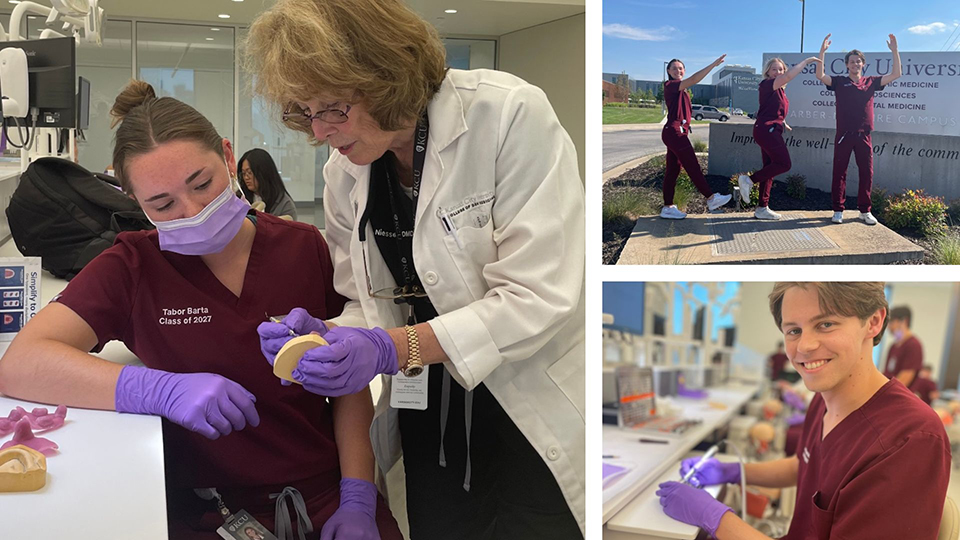
When Tabor Barta ’22 was growing up in Holton, Kansas, population 3,386, she never
dreamed she would have the opportunity to be part of a new health school with the
mission of improving the well being of a community just like hers. While in college
she worked for four years as a dental assistant in the office of Manhattan endodontist
Dr. Christopher Smith, but it was in an elective jewelry class she took at K-State,
learning wax castings and metal work, where she finally realized she had the hand
skills necessary to be a dentist: "I can do this."
The father of Amy Schaulis ’22, Dr. Brian Schaulis, is a general dentist in Salina,
Kansas. She used to help out in his clinic in high school, but her primary interest
was in art. Then at K-State she discovered the Kansas Mission of Mercy, a dental clinic
that provides free oral health care to patients of all ages who cannot otherwise afford or access care. Going on missions renewed her interest in dentistry. Soon she was doing work in
the phage hunters research class under Martha Caldas and Christopher Herren and taking
a human cadaver dissection course. (Editor’s Note: Phage hunting refers to the search for previously unknown viruses
that infect bacteria.)
Nolan Conrad ’23 grew up in Wichita, Kansas, and was interested in interior design.
But after shadowing a number of dental specialists in his area, and discussing his
plans with his mother, a registered nurse, he started to think of pursuing a health
care career. He toured a number of colleges in the state and decided that the pre-dental
curriculum at K-State best fit his goals. Barta connected him with a job at Flint
Hills Endodontics, and Schaulis got him involved with the Kansas Mission of Mercy.
Soon the three friends were heavily involved in the pre-dental club and planning their
move to the next level.
When the call went out to fill the slate for the first year class at Kansas City University's
College of Dental Medicine, founding dean and vice provost for oral health, Dr. Linda
Niessen, told applicants she was looking for 80 pioneers who wanted to make a difference.
She wanted students who were hard working, compassionate, experienced in community
service, with a history of giving back and a goal to practice in rural and small town
communities. In return she offered the opportunity to learn in a state-of-the-art
facility under an innovative curriculum with a faculty invested in their success.
Barta, Schaulis and Conrad are three of the students in the inaugural class of the
new college in Joplin, Missouri.
***
After the devastating Joplin tornado of 2011, which destroyed a major hospital and
led to over 160 deaths, city founders beseeched state and local health universities
to open a medical school branch at the site of a temporary FEMA hospital. Kansas City
University, which has run a College of Osteopathic Medicine in downtown Kansas City
since 1916, agreed to provide training in osteopathic medicine there and graduated
their first class in 2021. Soon after, city leaders helped raise money for a $65 million
Oral Health Center which opened in 2023. Joplin is currently the smallest city in
the country with both an osteopathy and a dental college.
For Barta, going to K-State was never in doubt. Both her father, Brooks ’93, ’97,
and her brother, Mason ’19, ’21, played football for the Wildcats. Her mother, Tonya
’91, is a current member of the K-State Alumni Association Board of Directors. On
her pre-application tour of KCU, she was impressed by the emphasis on teamwork, respect
and personal responsibility.
"The building was open and welcoming. And Joplin is a big town with a small town feel,”
Barta said. “People seem to care about each other. Just like in Manhattan."
To Schaulis, the KCU mission statement "Improving the health and well being of the
communities we serve" was appealing.
"I'm used to a school that is staffed with teachers who take the time to work with
the students to meet their goals," Schaulis said.
And in her experience the student body should match those ideals. At K-State Schaulis
was an officer in the pre-dental club and helped mentor classmates. She sees parallels
in her new school.
Dean Niessen jokes that they want to be known as the "Ted Lasso of dental schools,"
where students are encouraged to be curious, not judgmental. "Students learn better
in a noncompetitive environment. At KCU they are all part of Team Joptimism."
While a student at K-State, Conrad found the human dissection course challenging. But Jessica Martin was impressed enough
with his work to hire him as a teaching assistant for the class. The confidence and
wisdom he acquired in this position at K-State has led to his volunteering to be the
anatomy tutor coordinator for the incoming 2028 dental school class. In a similar
fashion, Conrad feels the faculty at KCU seem invested in seeing the class succeed, emphasizing cooperation
as opposed to competition.
***
Joplin has a small town vibe and community spirit, as well as a similar size to Manhattan.
K-State grads studying at the dental school might even bump into a few of the K-State
alumni around town, such as Andy Ostmeyer ’84, editor of the Joplin Globe; noted philanthropist Dorothy Bramlage Willcoxon ’63; Dean Van Galen ’86, president
of Missouri Southern State University; or any of the 10 K-State grads presently enrolled
in the osteopathy college.
Health care access is an issue impacting economic and workforce development across
Kansas, and dental care access is an important part of that. These students will have
the opportunity to work and learn in underserved areas, as part of the dental school
curriculum is to spend clinical time in Federal Qualified Health Centers in the area.
All the counties in the 100-mile radius of Joplin are designated as dental health
profession shortage areas. This includes parts of Kansas, as well as Oklahoma, Arkansas
and Missouri. Thirty-six of the entering first class of 80 are from the four state
area. Eight are from Kansas.
"It is hoped that they all will consider returning to their communities to serve people
with dental needs," Niessen said. "You can't have good health without dental health."
During their orientation program prior to starting class work, the incoming students
wrote and signed a class creed defining their goals for the next four years. Words
like "trust, honesty, oneness, inclusive joy, reliability" are sprinkled throughout
the creed. For Barta, Schaulis and Conrad, it is lessons learned as undergraduates,
where they shared classes together, attended meetings, and plotted their paths as
members of the future generation of health care providers.
Speaking at the first dental white coat ceremony in August 2023, Chief Glenna Wallis
of the Eastern Shawnee referenced the animals on her tribal flag: the swan symbolizing
calm and dignity, and the panther representing courage and determination. "Sometimes
in your career you'll have to be the panther, and sometimes you'll have to be the
swan."
These three K-State alums agree. But in addition to their panther head and their swan
heart, they know they will always have their Wildcat pride.
— Special thanks to guest writer John Lonergan ’74.