
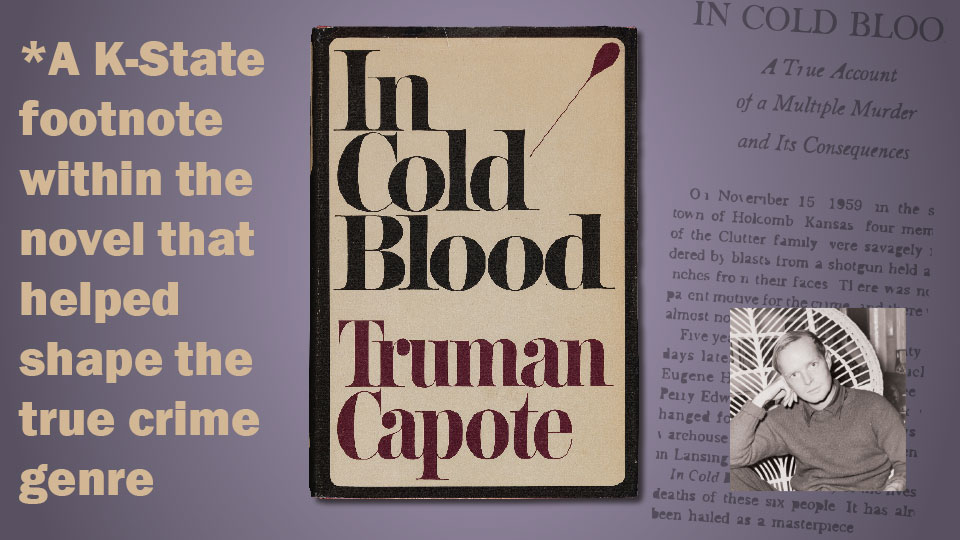
A K-State assist aided author Truman Capote with novel that helped define the true crime genre



By Tim Schrag ’12
Letters provided by the Richard L. D. and Marjorie J. Morse Department of Archives and Special Collections
Editor's note: This story originally ran in the winter 2025 issue of K-Stater magazine. Members of the K-State Alumni Association can read more exclusive content like this in each issue.
In 1959, authors Truman Capote and Harper Lee ventured to western Kansas to cover the murders of the Clutter family in Holcomb, Kansas.
Herb Clutter ’33 operated a thriving farm in Finney County that employed 18 farmhands. He previously worked as an Extension agent for K-State. On the night of Nov. 14, 1959, Clutter, his wife, Bonnie, and their children, Nancy and Kenyon, were murdered by ex-convicts Richard “Dick” Hickock and Perry Edward Smith, recently paroled from the Kansas State Penitentiary.
Capote’s reporting work would first appear as a serialized story for The New Yorker in 1965 and would later be published as a novel, In Cold Blood, in 1966. His work is often considered the prototypical true crime novel.
True crime is one of the most popular genres in the U.S. According to the Pew Research Center, 34% of U.S. podcast listeners indulge in the genre. True crime stories are non-fiction works where an author examines a crime, its details and the people associated with and affected by the crime.
In Cold Blood is the second-best-selling book in the true crime genre’s history, behind Helter Skelter (1974) by Vincent Bugliosi about the Charles Manson murders.
The ability for Capote to report on the murders and eventually write In Cold Blood would not have happened without help from Kansas State University. Capote even noted that in the book’s acknowledgements section:
“However, I do wish to thank certain persons whose contributions to my work were very specific: Dr. James McCain, President of Kansas State University…”
President McCain and Capote formed a friendship through Capote’s publisher Bennett Cerf, who co-founded Random House. Cerf met McCain while visiting K-State to give a lecture and meet with several English classes. Capote came to Cerf to help make connections before traveling to Kansas. Cerf knew exactly who to call and recalled the encounter in his memoir:
“One day Truman walked into my office and said, ‘The New Yorker is sending me out to cover that murder case.’ I said, ‘You? In a Kansas hamlet?’ That was the first reaction of everybody – the elegant Mr. Capote going to a small town in Kansas. He was quite indignant at my surprise, then said, ‘I don’t know a soul in the whole state of Kansas. You’ve got to introduce me to some people out there.
“That’s what a publisher is for, I guess, and this was one time I could deliver the goods. I immediately remembered my friend Dr. McCain at Kansas State. I called him up and asked if he had known the Clutter family in Garden City. Jim said, ‘The Clutters were my close personal friends. I know everybody in Garden City, Kansas.’ I said, ‘One of our authors is coming out to write a series of stories for The New Yorker, and I hope it will also be a book. Can he stop off on the way and visit with you? He said, ‘Who is the author?’ I said,
‘Truman Capote.’ Jim McCain echoed me, ‘Truman Capote? Coming to Kansas?’”
McCain told Cerf if Capote would spend an evening talking to the English Department, he would write letters to half of Garden City vouching for him.
Two days later Capote and Lee arrived in Manhattan. According to documents in the Morse Department of Archives and Special Collections Capote wore a pink Dior jacket to the meeting.
Capote announced, “I bet I’m the first man who has ever come to Manhattan, Kansas, wearing a Dior jacket.”
McCain replied, “I’ll go you one better, Mr. Capote. You’re probably the first man or woman who ever came to Manhattan, Kansas, wearing a Dior jacket.”
President McCain arranged for a luncheon in the K-State Student Union that included mostly people from the School of Agriculture who had known Herbert Clutter. Earle Davis, chair of the English Department, also attended. Davis famously recalled the meeting in a 1984 edition of The Manhattan Mercury.
“Capote frankly has preferred male companions,” Davis wrote. He also noted that Capote and Lee traveled with two large trunks filled with liquor and other provisions, because someone had incorrectly told Capote that he couldn’t buy liquor in Kansas.
That evening, an additional party was held also at the Union for the English Department to meet with Capote and Lee.
“Local lore has it that Capote spent a summer with Davis in his house at 1711 Fairchild Ave. working on his book, but that cannot be substantiated,” wrote Anthony Crawford, former university archivist, for K-State Keepsakes. “It would appear that Davis would have mentioned this residency in his ‘memories’ piece (and it is difficult to imagine Capote staying in Kansas for an extended period!)”
Because of this encounter, Capote was able to successfully research the crime and
complete In Cold Blood. McCain recalled the meeting in a document found in the Morse
Department of Archives and Special Collections:
“Truman Capote interviewed me in my office, and stayed in the President’s Residence.
I arranged for officials in Garden City to help him with his research. People were
quite frightened in Garden City after the Clutter killing; for example, they bought
all the locks in the hardware stores to bar their doors to the murderers, who were
still unknown and at large.”
After the encounter, McCain and Capote exchanged letters. Those letters are among the McCain papers housed in the Morse Department of Archives and Special Collections. The letters are warm and exchange a real desire by both parties to connect again in Manhattan, though this never substantiated. One of Capote’s letters to McCain ends with “All good wishes to Janet,” who was McCain’s wife.
“It is clear that Capote valued their friendship and the assistance that McCain gave him while writing In Cold Blood. Among the few individuals that he singled out in the book’s acknowledgments, McCain is mentioned first,” Crawford said.
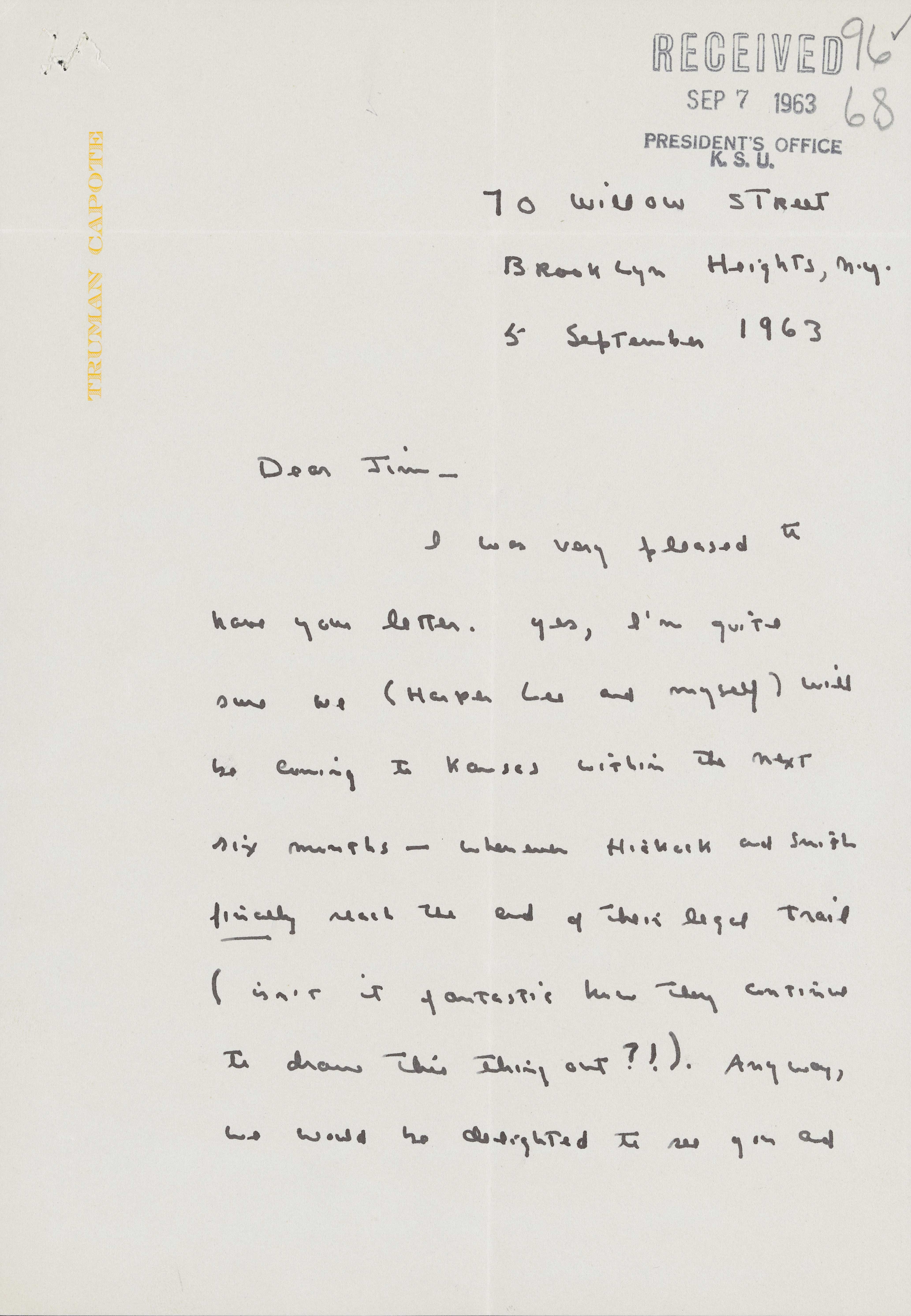
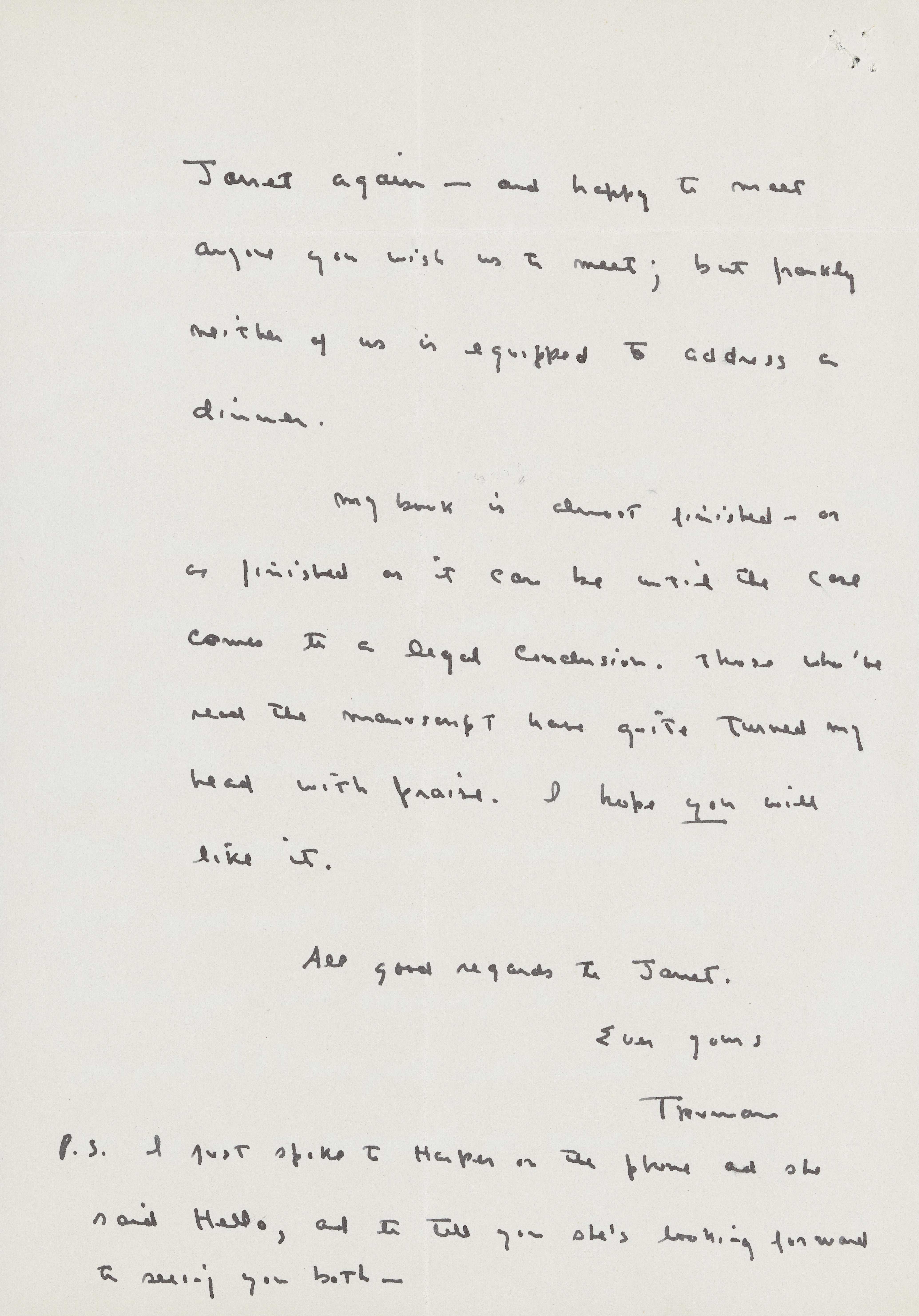 A 1963 letter from Truman Capote to K-State President James McCain.
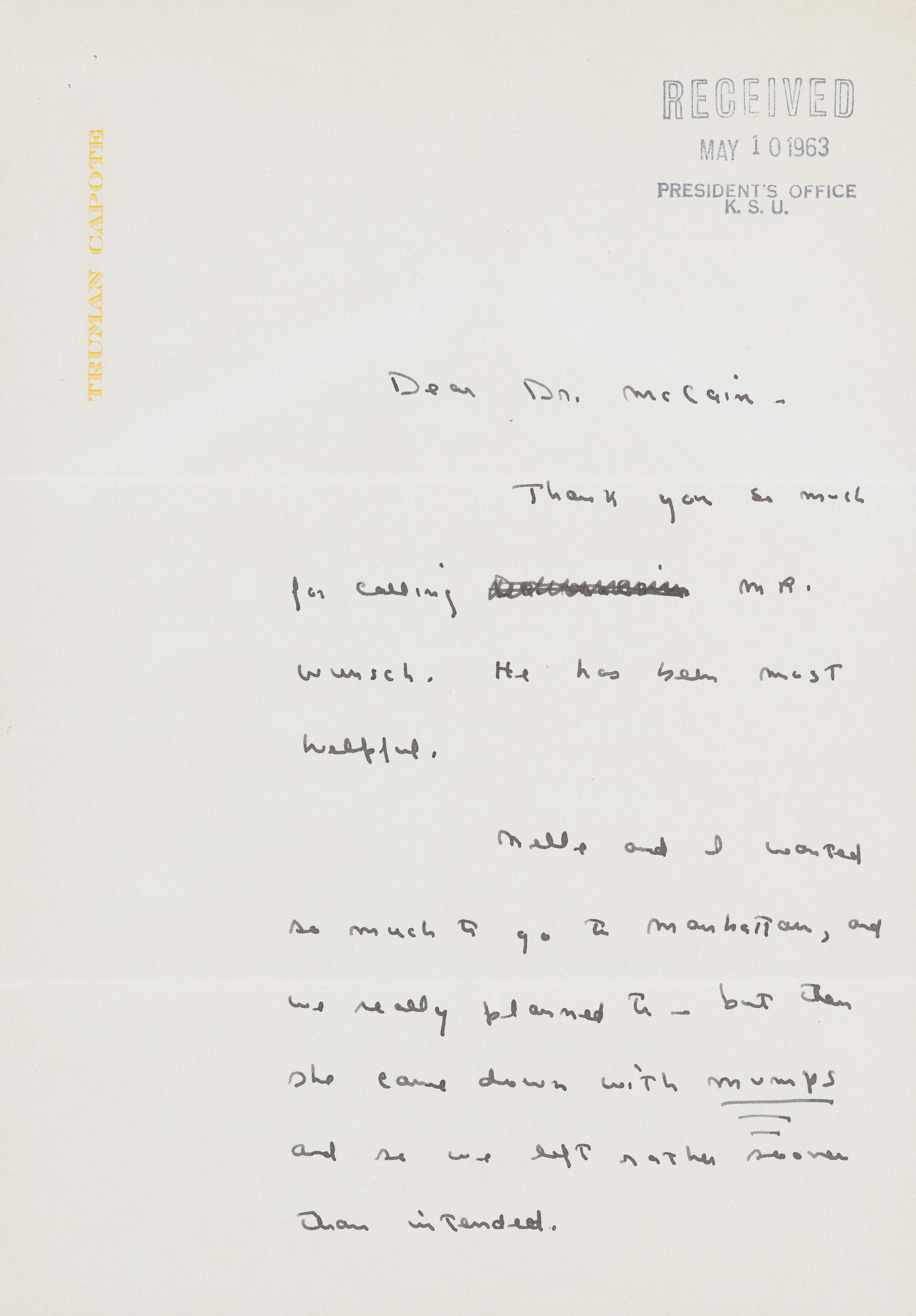
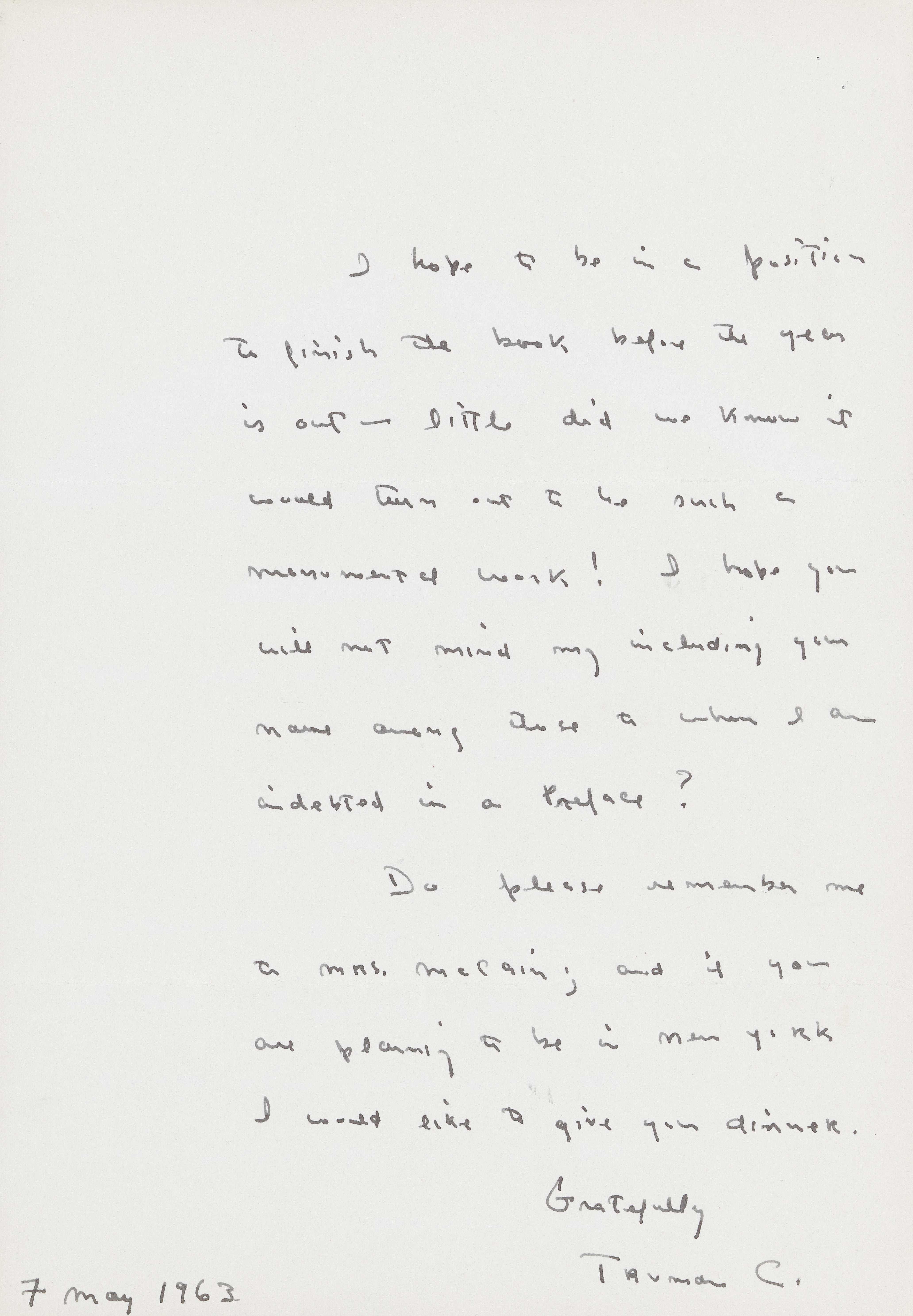 A second letter from Capote to McCain in 1963.
 A letter from President McCain to Capote in 1966.

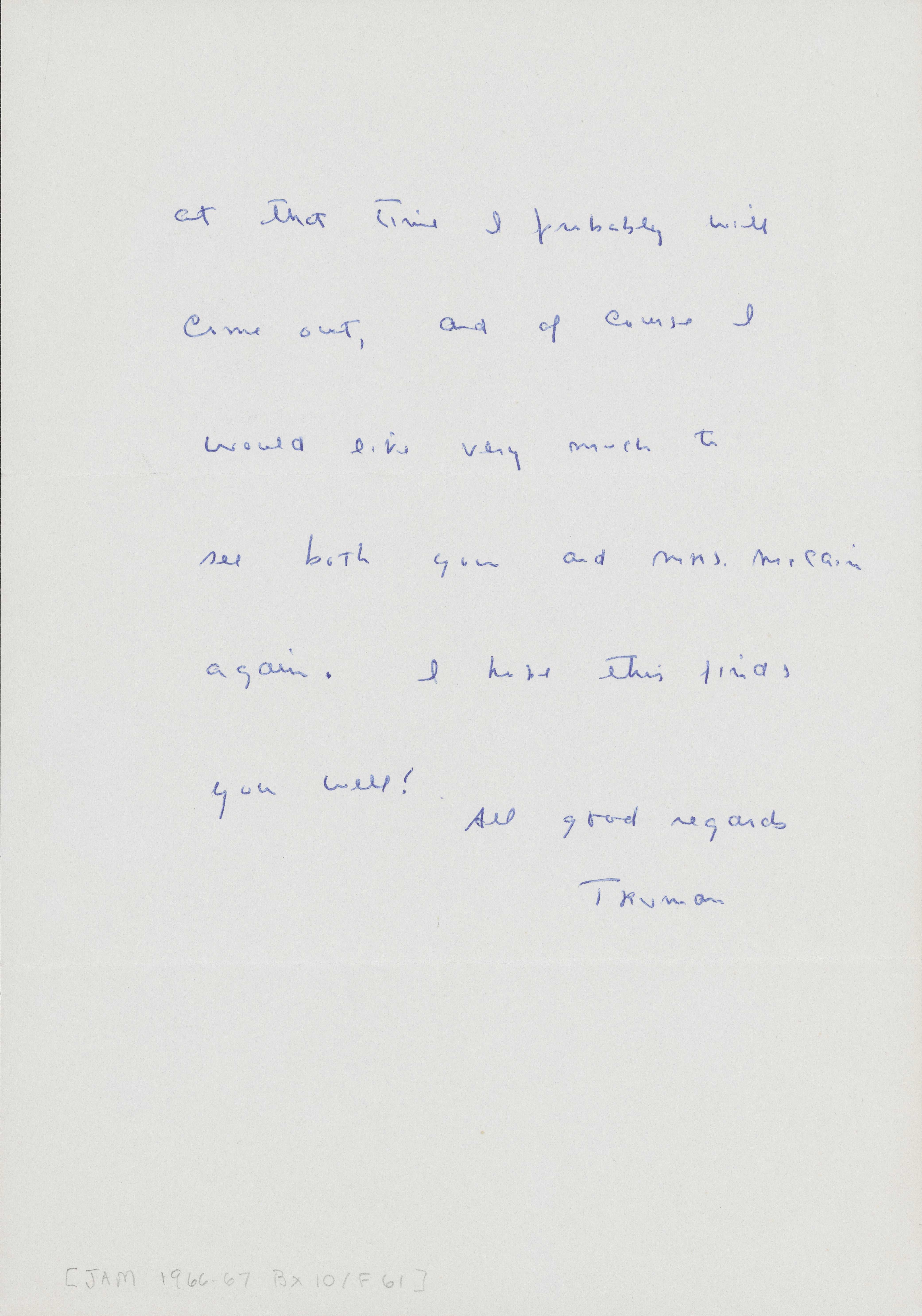 Capote's reply to McCain in 1966.