
K-State artist returns to campus to tell stories through mural project



By Ashley Pauls
K-State Alumni Association
When you walk through the doors of K-State’s Leadership Studies Building, there are
a number of details that first catch your eye as you spot the mural in progress by
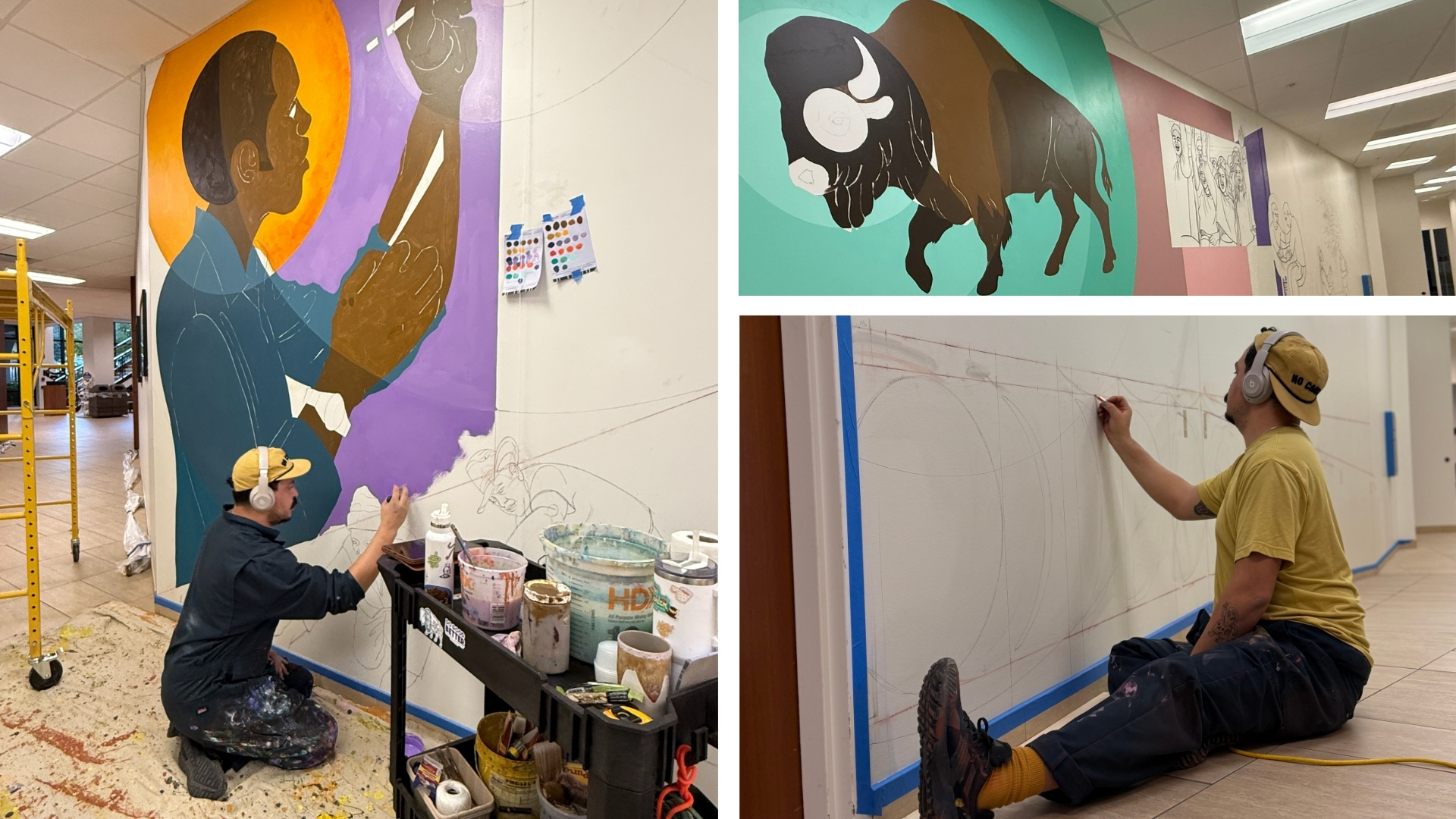
artist and former K-State student Armando Minjárez.
You’ll see bright colors, from bold lavender to sunny yellow to the vivid blue of
the Kansas sky. You’ll see symbols important to the prairie of the region, including
the bison and wildflowers. Finally, you’ll see a number of faces, some a part of K-State’s
history and some that speak to the possibilities in the university’s future.
All those individual details blend together to tell a story through an expansive painting
that wraps around two corridors in the building. It’s a distinctly K-State story,
and also a very personal story for Minjárez.
Minjárez is an art consultant, muralist and owner of a ceramics studio in Wichita,
Kansas. He said he was thrilled when the university reached out to him to commission
this mural, his first piece of public art in Manhattan. This was also his first time
to return to campus in about a decade; he last visited Manhattan for a performance
project titled Alienation, where he took comments from news articles written about his advocacy for immigrant
rights, put them on notecards, and then had people read the words out loud to him.
He also delivered a lecture on campus.
“It was very much a collaborative process,” Minjárez said of developing the new Leadership
Studies mural. “I would say they have been a dream client. They really left that to
me to come up with the concept, and I shared with them that part of my process is
to engage with community.”
Minjárez believes that community involvement is deeply important to the creation of
public art. By its nature, public art is an invasion of community space, and if people
have input ahead of time on what is being portrayed, the finished artwork often fits
more naturally into the environment.
“I think it’s really important for those people to be involved in a meaningful way
in the artwork that gets put in that space, so they have some sort of ownership,”
Minjárez said. “I want to engage the stakeholders; it makes it more meaningful to
me. I really enjoy getting to know people, and hearing their reflections and their
ideas. I grow from hearing people reflecting on life. It makes it worthwhile. It helps
me to stay grounded and hopeful.”
Before starting on the K-State mural, Minjárez visited campus to talk with Leadership
Studies students, as well as faculty and staff, about what it means to be a leader
and practice leadership.
After gathering this information, he created a board featuring the keywords and common
themes/values that emerged from his discussions. Students were then given three dots
to place by words/concepts that most resonated with them. All this data provided the
foundation for the mural.
“It’s always interesting to see what students are interested in,” Minjárez said. “For
instance, the Konza Prairie was one of the top five things that they were interested
in having in the mural.”
Freedom of exploration and expression
Minjárez originally came to K-State as a transfer student and said he had a wonderful
experience; he especially appreciated the collaboration between graduate students
and undergrads.
“We had a really tight-knit community,” he said. “It elevated the artwork.”
He also appreciated the flexibility offered by K-State’s programs; he explored classes
in a variety of art forms, including ceramics, painting and drawing.
“They allowed me to create my own experience here, and that just made my work stronger,”
he said.
During his time at K-State, he also began to delve into philosophical questions surrounding
the creation of art. He noticed that art history is often viewed through a more limited
Western/European lens, and a professor encouraged him to make art bringing awareness
to that topic.
Throughout his career, Minjárez has remained mindful about celebrating a wider range
of perspectives and traditions through his work, and to paint melanated skin.
“So much of the history of the place I come from and that shaped me was literally
destroyed,” Minjárez said. “I see that as part of my role as an artist, to continue
some of those, not just traditions, but understandings of the world.”
Bringing a vision to life
Another major inspiration for the Staley School’s mural project came about from a
visit to Hale Library’s archives and special collections. Minjárez viewed We Are the Dream, a student-driven mural in the library that was dedicated in 1980. This mural was
sponsored by the Black Student Union; Movimiento Estudiantil de Chicanos de Aztlan
(MEChA, a Hispanic student group); and the Native American Indian Student Body. According
to Hale Library, the mural is “an important record of the struggle of K-State’s underrepresented
students to be seen and heard.” (LEARN MORE)
After the 2018 Hale Library fire, the mural was removed from the wall, restored and
reinstalled near the Academic Learning Center, a study and tutoring space for student-athletes.
“For some years, [the mural] was sort of a little bit hidden,” Minjárez said. “So
all of that showed me then, the university cares about art, they were having some
really thoughtful conversations about the mural and where it was located, do we paint
over it, what does it mean for it to be witnessed or not by students? Eventually,
it was preserved, relocated and reinstalled; all of those were positive signs that
the university not only cared about the art itself, but also about the message and
the intention.”
Minjárez’s Leadership Studies mural features two of the driving forces behind the
We are the Dream mural: Harold Carter and Teresa Guillen.
“For me to be a K-Stater, to be invited to paint this, [the We Are the Dream muralists] were imagining a world where they can just bring their full selves into
who they are and what they do, despite all the challenges they were facing,” Minjárez
said. “In a way, I’m kind of living in the vision that they were imagining for themselves.
That was really powerful.”
Two current K-State art students, Sue Fang and Rita Hawzipta, have been assisting
Minjárez with the painting project, and some classes have also stopped by to view
the work in progress. He plans to return in January to finish work on the mural.
Throughout the process, students have stopped to compliment his work and express curiosity
about the project.
“Everyone’s been so affirming and welcoming. It feels really nice,” Minjárez said.
“To see a student with dark skin walk by and then see a dark-skinned person in the
mural, you see their smile, their expression. It makes a difference, to feel seen
and to be depicted in a way that is powerful. It’s those little interactions that
are very fulfilling.”
“Art has featured prominently in the Leadership Studies Building from the start, and
this mural project is contributing even more than we hoped for,” said Mary Tolar,
Ed.D. ’90, ’09, dean of the Staley School. “The community engagement Armando practices
in his art is what we teach and learn in leadership studies. He listened and engaged
broadly with students and our campus community — to connect, express and inspire reflection
and perspective. And the connection to previous student leaders who contributed through
art to our university tells a great story — of contribution and community.”
Want to learn more about the Leadership Studies mural project? Contact: leadership@ksu.edu