
K-State connections: Heather Wilkins ’08 shares how her education sparked her career as an Alzheimer's disease researcher



By Ashley Pauls
K-State Alumni Association
When Heather Wilkins ’08 reflects on her career trajectory — from her start as a microbiology
major at K-State to her recent promotion to associate professor of neurology at the
University of Kansas Medical Center — she traces her success back to one key factor:
mentorship.
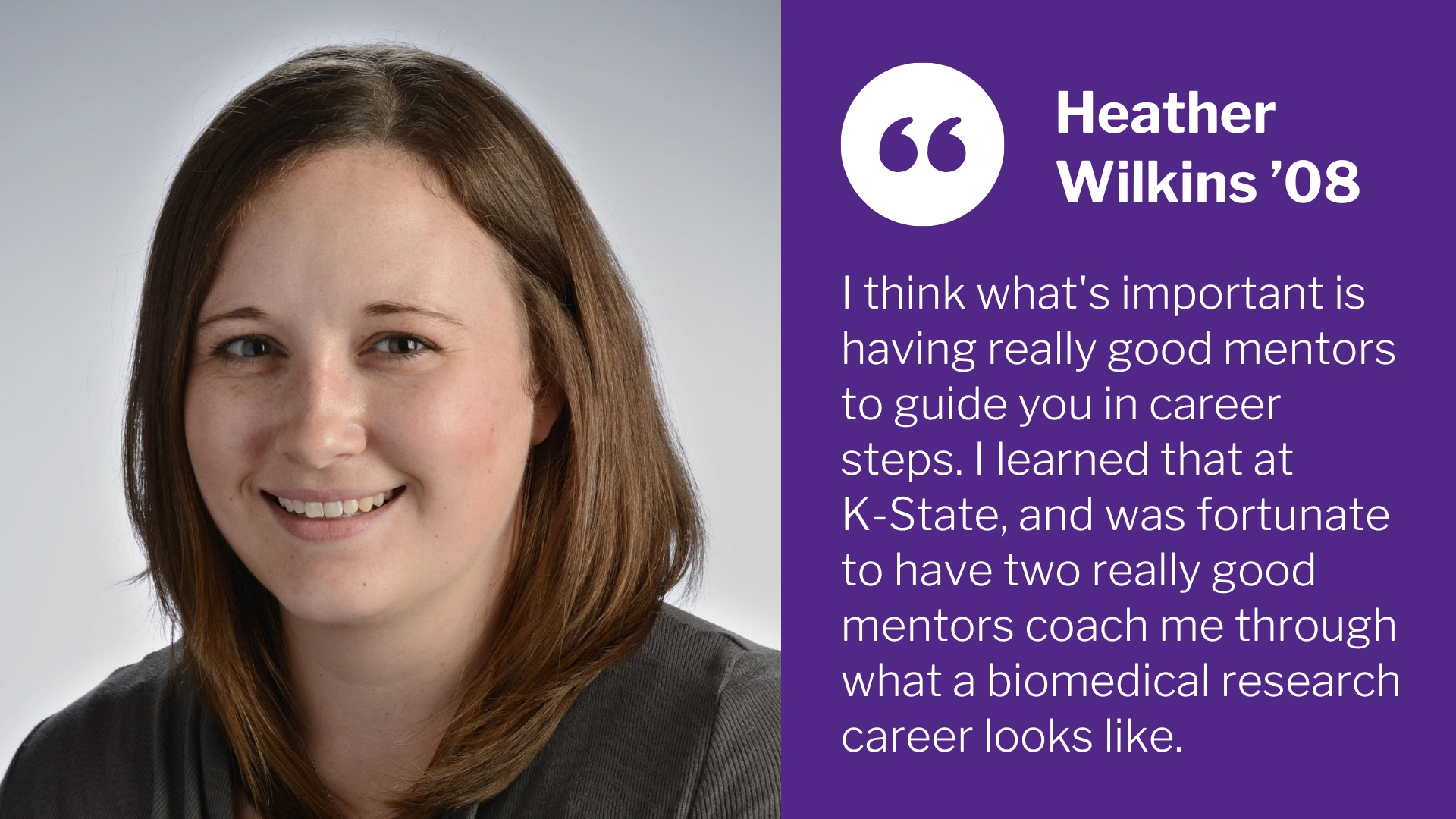
“I think what's important is having really good mentors to guide you in career steps,”
Wilkins said. “I learned that at K-State, and was fortunate to have two really good
mentors coach me through what a biomedical research career looks like. While classes
are important and great, it's also those connections and that mentorship beyond coursework
that was really helpful for my career.”
And even though her current research into Alzheimer's disease keeps her schedule full,
she makes sure to find time to give back to students as a mentor herself.
“It's really fun to watch people grow,” she said. “And then you build your own network
so that when future trainees are interested in something, I can say, ‘Oh, I know a
person who does that.’ Being able to reach out and have that network to help people
find opportunities is really important. I always tell mentees to maintain connections
even with other students that you might be working with in your cohort, because you
never know.”
Wilkins, who is a first-generation college student, said her goal was always to end
up at K-State. However, her original plan was to become a veterinarian.
She spent time in high school and during the summers volunteering at the Humane Society
in Wichita, Kansas, and shadowing the veterinarians. When she got to K-State, she
started attending pre-veterinary club meetings.
“I was listening to one of the veterinarians talk about the biomedical research they
were doing,” Wilkins recalls. “And so that's when I started to become more interested
in the research side and talking with professors about that. I wound up majoring in
microbiology, and then I added on a chemistry minor, and that really prepared me for
graduate school.”
Wilkins’ graduate school dissertation focused on amyotrophic lateral sclerosis, which
is commonly known as ALS. She studied mitochondrial function and energy metabolism
in relation to that disease; mitochondria use oxygen to convert substances from food
into energy to power your body's cells.
“I wanted to continue studying energy metabolism and mitochondria, because it's always
interested me and I find it to be a central part of many different diseases,” she
said. “Around 2013 articles cited Alzheimer's disease as ‘type three diabetes.’ I
have been type one diabetic since the age of seven, and while I never wanted to do
research directly on type one diabetes I did want to do some sort of research that
was relevant. And so that's what piqued my interest in Alzheimer's disease.”
Wilkins said she is grateful for the supportive environment at KU Medical Center that
has allowed her to grow a research program looking at how mitochondria may influence
Alzheimer's disease pathology.
Wilkins reports that one of the major challenges with current research into Alzheimer’s
disease treatments is severe side effects, such a brain bleeding or swelling, or the
fact that even if a potential therapy makes it to a clinical trial, the treatment
may fail.
Wilkins’ lab has been working with skin cells from consenting volunteers that are
turned into adult stem cells. Those stem cells are then transformed into “cerebral
organoids,” or miniature models of the human brain.
“I am working with a student who's doing drug testing in those to see what works,”
Wilkins said. “The other issue is, we don't have good measures to tell us if a therapy
is improving mitochondrial function or energy metabolism. Maybe therapies fail, because
they're not actually having the intended effect, or they are having the intended effect
and it's not the right thing to try to improve. So we also work on developing biomarkers
that can measure mitochondrial function and metabolism.”
She’s also continuing her ALS research, hoping to find a breakthrough that may improve
the knowledge base about multiple diseases.
“I carried it forward, because a lot of these diseases have very common issues,” she
said. “I feel like if you can figure something out in Alzheimer's disease or ALS,
it will probably apply to the other as well, and be helpful.”
Although much work remains to be done, Wilkins is hopeful, and also excited about
where the future will take her. And in the meantime, she continues to do whatever
she can to support the next generation of researchers.
“I still keep in touch with them,” she said of the students she’s mentored. “One of
them is now a maternal fetal medicine doctor at Oregon Health. We published papers
together while she was an undergrad, and she's reached out because she sometimes needs
help with bio stats in her studies, and so I'll help with that.”