
K-State Salina embraces technology like virtual reality and AI to prepare students for next-generation careers



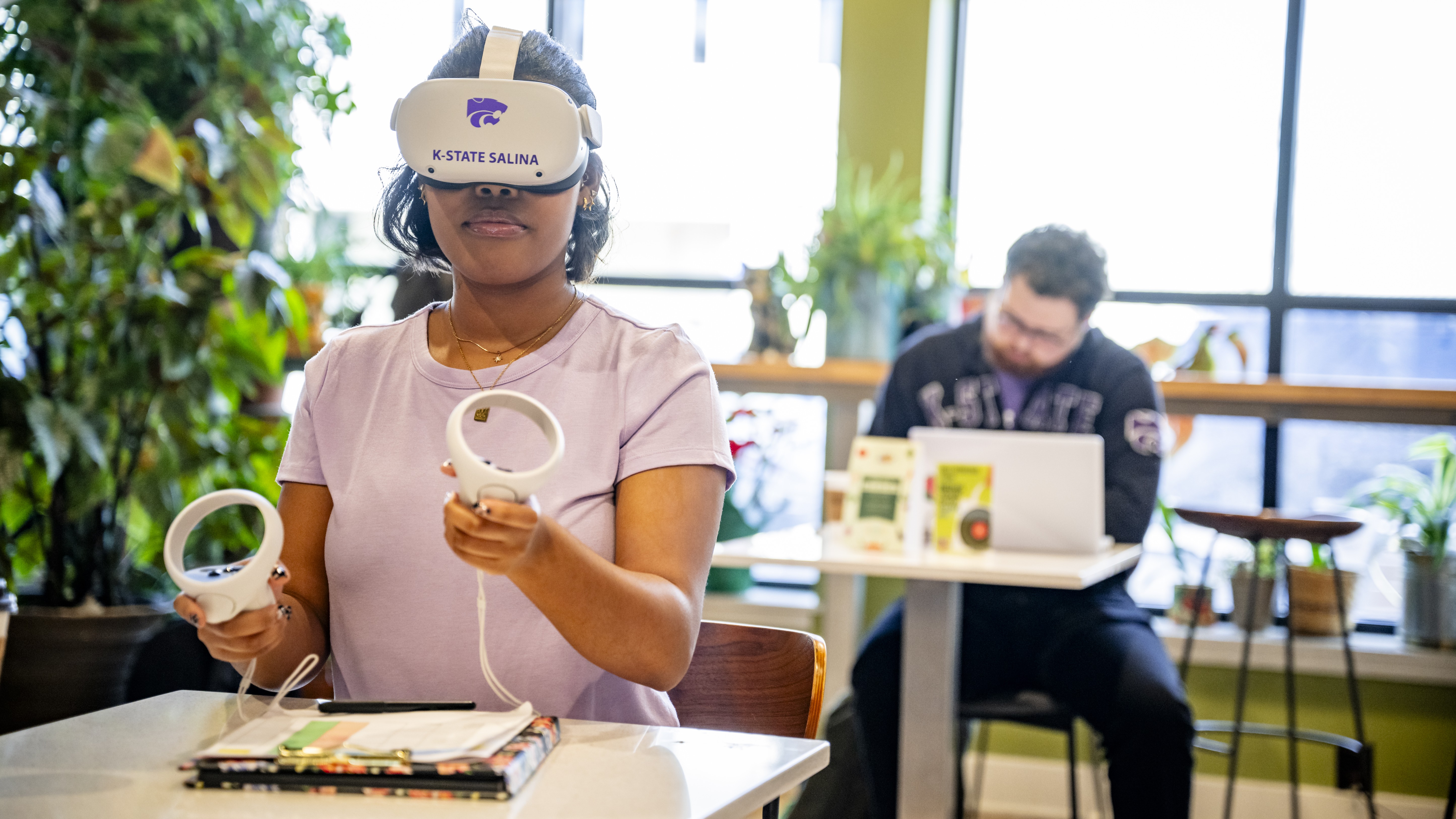
Imagine this: A student is immersed in cutting-edge technology, learning from industry
experts who bring years of research and real-world experience into the classroom.
They sit at a desk in a traditional setting, and they can see their fellow students
sitting beside them, intently listening as an instructor writes on a board or discusses
the lesson of the day.
What unfolds next is anything but ordinary.
At the end of class, the student slides off their virtual reality, or VR, headset,
and opens their eyes not to a classroom, but to their living room, a work office or
even a coffee shop.
This isn’t a vision for the future — it’s a reality today for many students at Kansas
State University Salina.
Jeremy Bohn '13 with K-State Salina Communications and Marketing recently took a deep dive into how K-State Salina, through the integration of virtual environments, is redefining the
educational experience, connecting learners across the globe in real time.
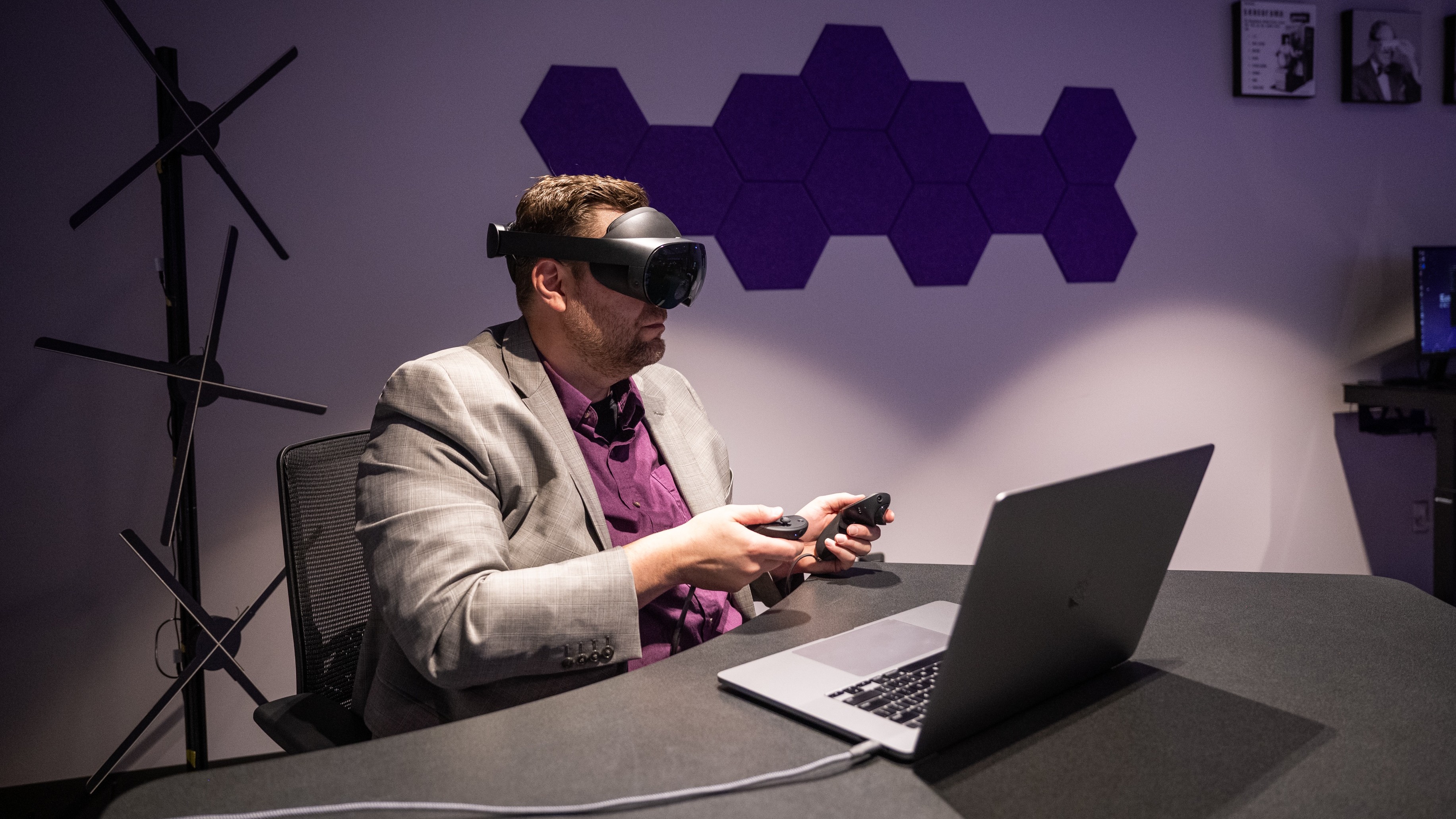
"Through these VR headsets, we have a virtual classroom that we can step into with a whiteboard that we can draw on," said Henry Kerschen, senior in computer systems technology, Olathe, Kansas. "This campus has done a great job of preparing all of us to have that real, thoughtful development as we’ve worked. This has been a fully comprehensive experience and it’s given me a good base foundation of information that I can really take with me anywhere."
As Kansas State University’s College of Aviation and Technology, the Salina campus
is setting the standard for technical education, especially in the aerospace and technology
industries.
Through its expertise in pioneering technologies such as artificial intelligence,
augmented reality, virtual reality and cyber-physical systems, K-State Salina is shaping
the future of education and advancing the mission of Kansas State University as the
next-generation land-grant university.
“The instructors at K-State Salina have done a great job of introducing us to new
technology,” Kerschen said. “As students, we have this unique opportunity to play
with VR headsets and engage in that immersive experience, and we have a lot of tools
that allow us to get hands-on with our own educational experiments.”
In August 2024, K-State Salina broke ground on facilities for its new, one-of-a-kind
partnership with Pure Imagination Studios, a global leader in immersive entertainment.
This collaboration led to the creation of the K-AIRES center, a $41 million, 47,500-square-foot
facility that will be a hub for cutting-edge education and innovation. K-AIRES will
house a production lab for Pure Imagination Studios, which has worked on high-profile
projects for Netflix, DreamWorks, FOX, The LEGO Group, Marvel Entertainment and others.
“Our students will be working alongside Pure Imagination employees and creatives learning
how the industry works,” said Michael Oetken, assistant professor in immersive systems
design and director of K-AIRES. “They’ll get to work on projects with Pure Imagination
Labs as well as engage in experiential learning with K-State Salina faculty. It’s
an exciting new chapter in applied learning on our campus and a great way to gain
an education.”
K-State is not waiting for construction to be complete. Students are already learning
how to apply advanced technologies daily, from cyber-physical systems to how software
and data components interact with the world.
Students are already learning how to autonomously navigate drones through programming,
control systems, computer vision and image processing.
“At K-State Salina, we are changing the landscape of education,” said Balaji Balasubramaniam,
assistant professor in computer systems technology and graduate program coordinator
for the machine learning and autonomous systems certificate. “We are giving the students
the experience of using these advanced technologies in the classroom. Students are
provided opportunities to immerse themselves through work-study, hands-on projects
in class and assisting in research.”

K-State Salina is not only transforming higher education, but also preparing students
for careers in industries that are rapidly evolving.
One area seeing massive technological growth is agriculture, where K-State Salina’s
expertise in AI, VR and machine learning is making an impact.
Agriculture companies are embracing AI and digital technologies to enhance precision
farming. From tractor mapping software to AI-driven agricultural spray aircraft, these
innovations are making farming more efficient and cost-effective.
Austin Chart, a graduate student in integrated systems design and dynamics, Salina,
Kansas, is using K-State Salina’s advanced technologies to improve agricultural practices.
“Farming in general has been a lot more systematic, it’s become much more precision-based,
and that level of precision is becoming more and more accurate by the day, especially
with this type of technology,” Chart said. “Innovations like machine learning, autonomous
systems and AI help producers save money because farmers, using the tools and machines
at their disposal, understand their land best and know where to properly apply products.”
Students at K-State Salina have access to industry-standard tools like VR headsets,
robots, three-dimensional modeling software and programming software like Unreal Engine
— all of which allow them to experiment and build their own projects.
The combination of hands-on learning, industry partnerships and cutting-edge technology
sets K-State Salina apart.
Chart credits the hands-on nature of K-State Salina’s courses and the faculty’s connections
to industry in helping him prepare to affect the agriculture industry with new technologies.
"Getting your education at K-State Salina feels a little bit like you’re at Hogwarts," Chart said. "We’re not just reading a book — we’re learning the spells. Students are creating programs, creating games and doing these things hands-on and in real-time. I think it’s something that distinguishes K-State from a lot of others around country."
— This article was written by Jeremy Bohn '13 with K-State Salina Communications and Marketing, and was originally published at the following link.