
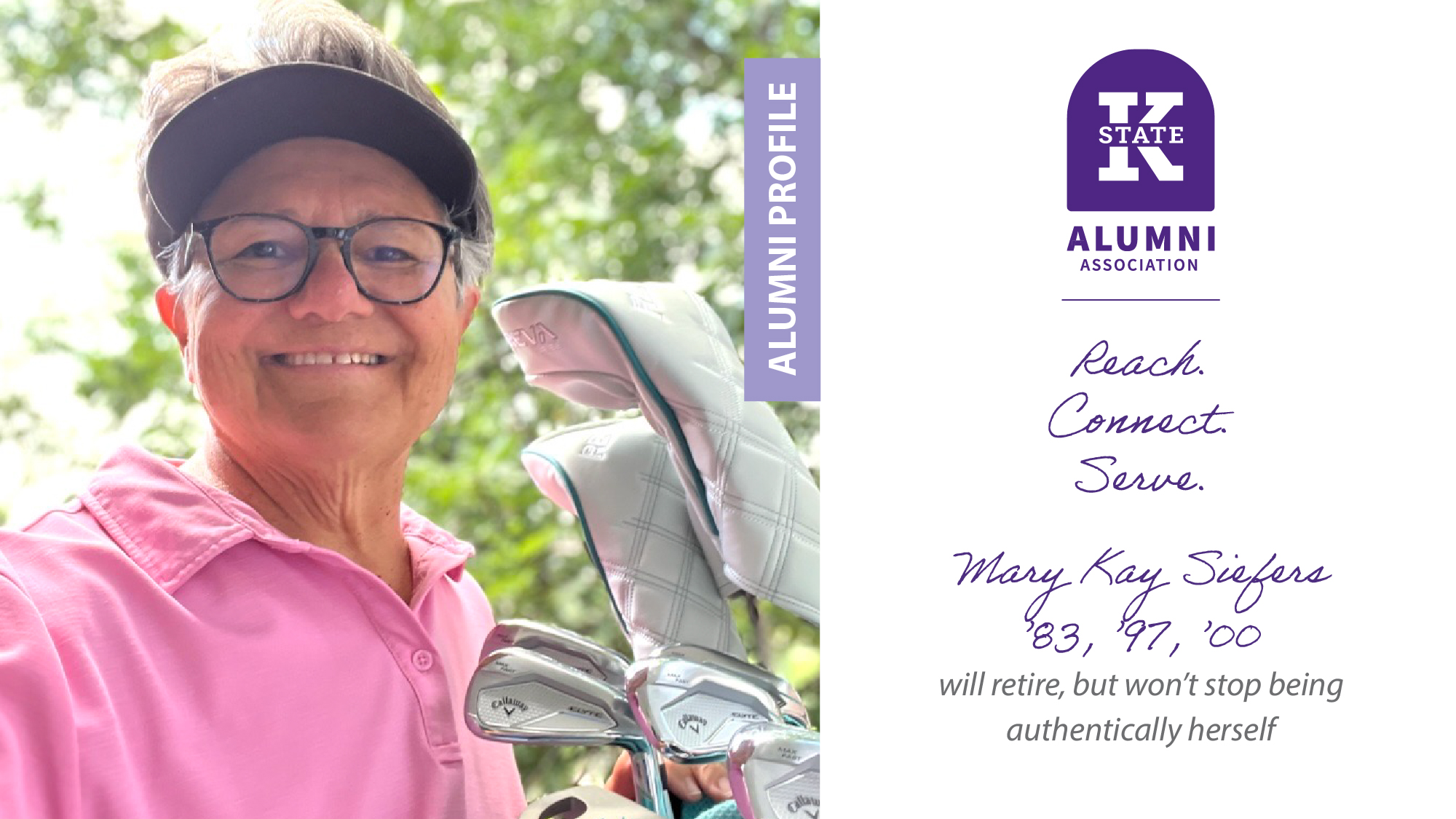
Mary Kay Siefers will retire, but won’t stop being authentically herself



By Tim Schrag'12
Mary Kay Siefers ’83, ’97, ’00 is about to take her own advice and have the “best damn” retirement ever.
“This is how I end every class. I tell my students to ‘have the best damn day you've ever had. Now get the hell out of here,’” she said.
She’s known as something of a cutup in the classroom.
“I think it's just who I am,” she said. “I know that humor can knock down some barriers for some people. I don't want to go there and be bored. I value that 50 minutes or hour and 15 minutes that I have with each class period, and if I'm bored, I know they're bored.”
The point of using humor, beyond being authentic, Siefers says, is to get her students to be willing to explore the challenges of the world, and think about ways they can make a difference.
“To give them that skill set and agency where they can feel like they can use their voice and their talents; to go out and make change,” she said.
Siefers retired from K-State as a teaching professor and director of Global Food Systems Leadership Program in the Staley School of Leadership at the end of the semester. The Staley School has been the place where Siefers said she’s lived her life most authentically. She’s been involved with the school and its programming since it was founded in 1997, first taking a women in leadership class from founding director Susan Scott.
“I bought into what Susan Scott and Bob Shoop were trying to do with this program,” Siefers said. “And it was intentional. It made my heart go pitter patter, and I thought, that's where I belong, and that's the work I want to do in the world. I think in Susan, I could see that it takes all people, and we all have gifts to give to the world. And what she was giving was, those soft skills that weren't as prevalent [in the mid to late ’90s] as they are now.”
So she got to work as a grad student studying animal science, where she earned a master’s degree followed by a Ph.D., all the while helping the school by teaching courses in leadership. Eventually a faculty position opened with the Staley School and she took it.
“30 years ago, we were teaching different things than we are now because the world that our students live in is different than the world we lived in 30 years ago,” she said. “But the idea that I can make a change in my community, whether that's my family, my living community, my hometown, the organizations I'm in, in the faith communities I might be in, or service organizations that I’m part of. And I can lead, which is different than being the president or the vice president, but I can lead. That's why my heart went pitter patter.”
In her classes Siefers asked students to think broadly about complex challenges, issues and problems and not just grasp at low hanging fruit. This could be about the cost of food and how grocers keep prices low, how migrant workers impact food prices and workers rights, or just about general complex issues that don’t have simple solutions. No matter what, Siefers wants her students to search and deliberate, especially on how to address those wicked or adaptive problems where solutions aren’t simple.
“When they go out in industry, I want them to be able to think. Think boldly. Be solutions oriented,” she said.
During her time at the Staley School she also met her wife, Nancy Fager Bolsen ’81, ’85. Coming out, Siefers said, allowed her to live authentically, which she said happened over time. Essentially, she had as John Denver puts, “come home to a place she’d never been before.”
“Once I could be free of the weight, it's like I could give my gifts so much better, impact people so much more, and make my community a better place,” she said.
Over the years Siefers has taught many courses including cultures in context, leadership in practice and more. In 2017 she began teaching courses surrounding leadership within global food systems. This lead to an eventual secondary major in global food systems leadership through a collaboration between the Staley School and the College of Agriculture.
“We wanted to develop students who could operate and see the global food system as a system, from a broad perspective,” she said. “So global food systems leadership enhances their study of agronomy, or enhances their study of nutrition, or enhances their study of ag econ. And in those disciplines, they're going to take a deep dive, right? But in global food systems, we're talking about the impact of things like having strawberries in Kansas in January? How does that happen based on a system? Our ag students, they're really committed. They are very mission driven. I love them, and so I love working with them to think broadly about these issues.”
The program is designed to encourage multidisciplinary dialogue and involvement among students across campus with diverse perspectives about global food systems leadership. A secondary major must be tied to a primary major and is intended to provide broad learning options to enhance the student's primary area of study. The global food systems leadership secondary major requires 24 credit hours, some of which may also be required for the student's primary major and also provides opportunities for focused course selection.
“I hope I've influenced people to make change for the better,” she said. “And entertain them along the way a little bit.”
Now heading into retirement, Siefers hopes to spend some time on the golf course; she’s a member of the Manhattan Country Club. But she also wants to continue her work, developing people, specifically in the food and agriculture sectors. She’ll do that by working to fight poverty and volunteering for local food pantries.
“I never thought of myself as being a country club snob,” she said. “I hope I'm not a snob, but you know what a country club is? It’s a lot like my classroom. It’s a community where people know your name and care about your story. There’s always a little uncertainty, plenty of opportunities to learn from mistakes, and occasional trips into the rough. The good news is you rarely have to find your way out alone.”