
NASA engineer and K-Stater already working on the next Artemis mission



By Tim Schrag '12
There wasn’t much time to bask in the success of NASA’s Artemis II mission for Erik Stalcup ’10, an engineer at NASA’s Glenn Research Center in Cleveland, Ohio. The mission successfully allowed a crew of astronauts to do a flyby of the moon, the first since the Apollo 17 mission in 1972.
“I think overall we were very happy with how things went,” Stalcup said. “I think there's things we can improve and get better on, but we do that every time. So it's definitely a good feeling to have it behind us, but I think we're in really good shape going forward.”
He’s already working on projects for the Artemis III, IV and V missions.
“They’ve got us thinking about all of them,” he said.
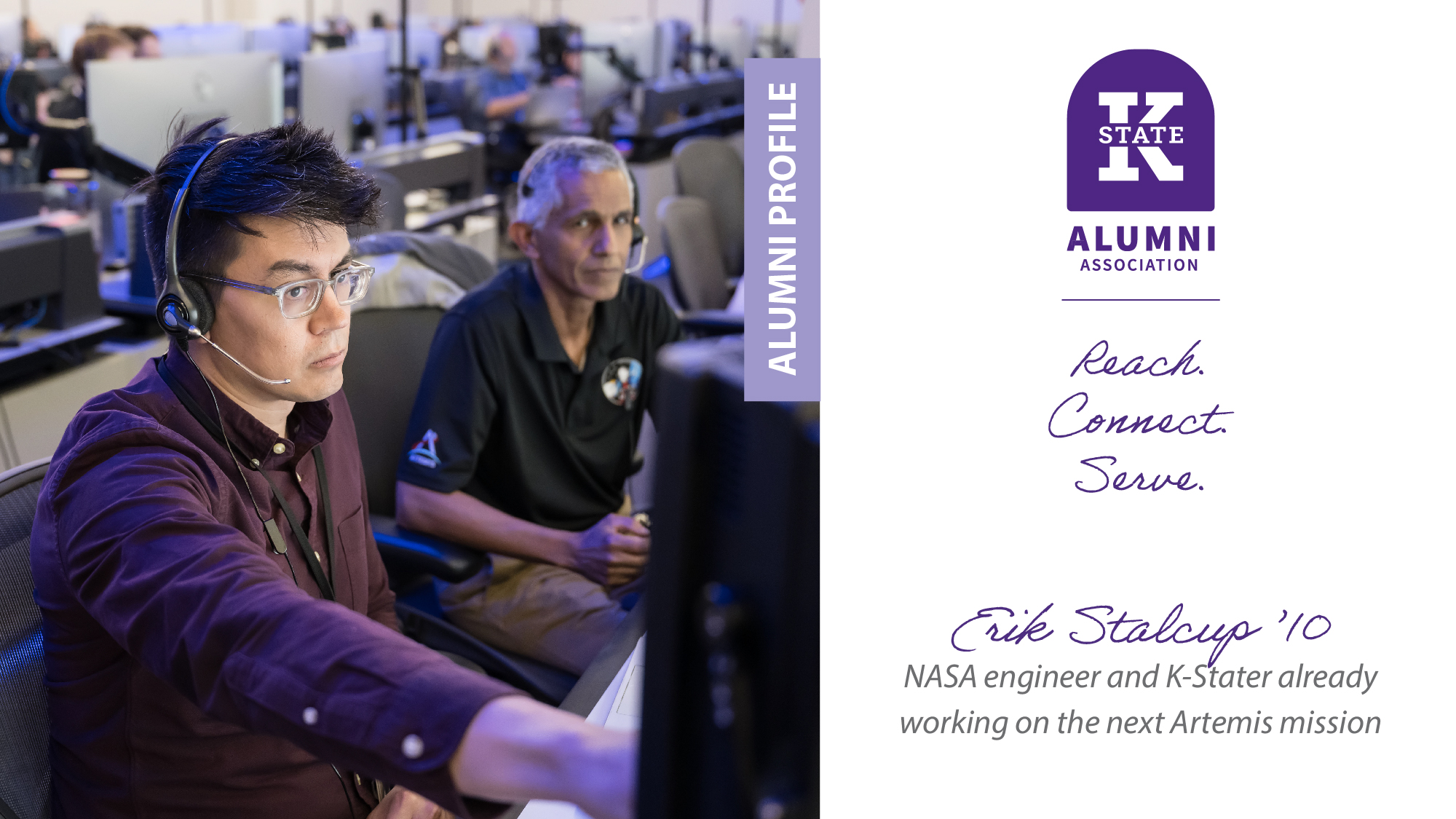
During the Artemis II mission, Stalcup assisted with Mission Control, working in the Mission Evaluation Room at NASA’s Johnson Space Center in Houston, Texas.
“It’s definitely very stressful because you're laser focused on the mission,” he said. “And our priority is the crew’s safety. So that's what we always have going through our heads.”
There’s a dull roar of busyness in the Mission Evaluation Room, Stalcup said. People are monitoring a wide variety of things during the mission to ensure success and crew safety.
“There's things going on all the time,” he said. “The Mission Evaluation Room that I work in, there's about 30 different consoles in there, and each console is a different subsystem or a different discipline. Everyone in there is monitoring their system 24-7, evaluating its performance, trying to troubleshoot any anomalies or failures that happen.”
Johnson Space Center houses historic buildings, like the site of Mission Control, which goes all the way back to the Apollo Missions in the 1960s and 70s.
“It's fun just to walk through the building,” he said. “It’s almost like a snapshot in time. They have preserved some of the old Mission Control rooms too, so that's really cool to see.”
In the Mission Evaluation Room, Stalcup monitored the passive thermal control systems, which are responsible for temperature control on the vehicle. The vehicle contained more than 600 heaters to keep necessary parts warm during the spaceflight.
“When you're flying in space, it's very cold,” he said. “One side of your spacecraft is always facing the sun, which actually makes it very hot, but then the other side usually faces deep space, which is really cold. So, a lot of times you end up having to heat things. And then there's thousands of temperature sensors we're monitoring on the hardware. We're basically making sure that all the heaters are functioning as we expect, all the hardware is within their operational temperature ranges.”
During each of his shifts at Johnson Space Center during the 10-day mission, Stalcup would monitor different areas of the vehicle during the spaceflight and report back to Mission Control. He said it was very much like an average day’s workload, just very intense.
“It’s a big step for science and for the U.S. space industry also,” he said. “This is something we haven't done in 50 some years. We've had to reestablish the capabilities to do that, not just in the NASA workforce, but in the industry and establish the facilities and the manufacturing capability to do these types of things. So it's great to get back to that.”
Stalcup’s work with the Artemis mission only makes up about half of his workload at NASA. The other half includes a portfolio of aeronautics projects including electrified aircraft.
“During the mission, I have a lot of other folks on my team that work with me on thermal control for electric aircraft, and so they were able to keep working while I was down at Houston,” he said.
Stalcup has been working for NASA for nearly 10 years. He said his time at K-State, especially in the physics department, helped him to successfully prepare for the rigorous work as a NASA engineer. During his time in Manhattan, he had several applied learning experiences working as an undergraduate researcher in professor Bruce Law’s lab doing research on ionic liquids. He also was selected as an honorable mention for the Goldwater Scholarship.
“The ability to do fundamental research, is very important,” he said. “Publishing papers is always a really good experience. Some of what I do is writing technical documents, things like that. Learning how to do that is a really good skill to have, and that definitely helps me in my day-to-day work.”