
Imagining the future: How a K-Stater’s new medical tech could improve disease detection and outcomes



By Ashley Pauls
K-State Alumni Association
Codi Gharagouzloo ’09 has big dreams for the future of his medical technology company
— big dreams that were, ironically, inspired by very tiny particles.
Through his dual major at K-State in mechanical engineering and physics, he began
studying the tiny bits of matter that make up our universe: atoms and even smaller
subatomic particles like protons and neutrons.
His imagination was sparked, and he continued exploring and learning. Today, he serves
as the co-founder and chief science officer of Imaginostics, a company dedicated to
developing safer, more precise MRI technology and improving diagnostics in cardiology,
neurology, oncology and more.
“What's kept my interest and continuing with this thing, is the fact that it's facing
physics and quantum physics, and then so many different applications throughout the
whole body, and lots of places in healthcare to help early detection, but also accelerating
drug development,” Gharagouzloo said. “It’s really an interesting space, because you
can't really beat a disease unless you can see it, and you don't know if your drug
is working on that disease unless you can measure it.”
Gharagouzloo’s father was stationed at Fort Riley when Codi was in third grade, and
he grew up in the same house in Manhattan, Kansas, from then through his undergraduate
years. K-State felt like the natural place to begin his college journey.
Long before he enrolled at K-State, Gharagouzloo was already showing an entrepreneurial
streak. Growing up in Manhattan, he parked cars in his family’s yard on K-State home
football game days — something he started as a kid and kept up from middle school
through high school. Those game days also led to a meaningful connection. It was through
parking cars that he met Joan Russell ’75 and Marlin Breer ’64, who generously offered
him a scholarship that helped support his undergraduate studies at K-State.
When he arrived at K-State, Gharagouzloo did not have a particular major in mind;
he simply decided to take classes that interested him, allowing him to explore a variety
of potential career pathways.
He worked for K-State’s Scholars Assisting Scholars program for a few years, tutoring calculus and engineering. He also quickly dived
into conducting research, even as an undergrad. He worked with Bruce Law in the university’s
physics department and even had opportunities to travel to the Max Plank Institute in Germany and ETH Zurich in Switzerland. He also joined the American Nuclear Society and loved getting to study K-State’s
nuclear reactor.
“I loved all things tiny, and I was doing this nuclear engineering thing, and just
learning about all the different stuff that goes on with particles, and that's where
my passion was kind of lying,” Gharagouzloo said. “It provided a really big foundation
for that, everywhere from particle physics research to nuclear engineering. I think
it provided me a broad enough perspective to decide what I wanted to do later on,
and it's a really good opportunity to learn so many different things.”
College shaped Gharagouzloo in ways that went beyond the classroom. It was during
his years at K-State that he discovered his Christian faith — a defining part of his
life that took root through two campus ministries, The Navigators and InterVarsity
Christian Fellowship.
He also minored in French and traveled to France on a study abroad trip with a group
led by Bob Clark, a beloved professor in the K-State French department who has since
passed away. It was during that time abroad that he met his future wife and business
co-founder, Valerie. He pursued a master’s program in Paris, at Ecole normale supérieure,
so he could be located closer to Valerie. He started studying biophotonics, which
explores how photons (quantum units of light) can be used for biological imaging,
such as screening for cancer.
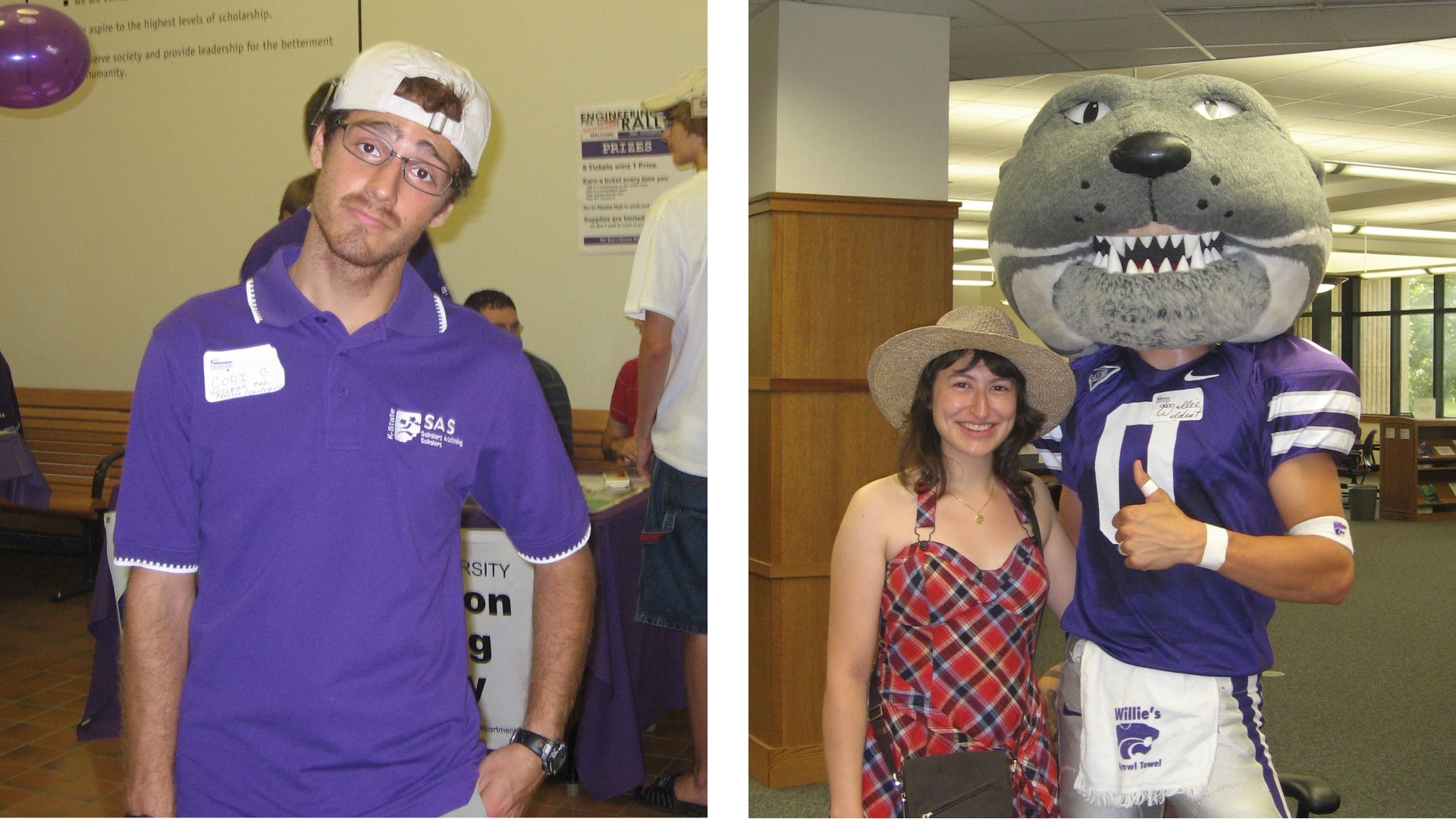
Codi and Valerie Gharagouzloo at K-State in 2007
Ideas began to spark in Gharagouzloo’s mind, and he continued his studies in medical
imaging technologies, working on his Ph.D. at Northeastern University and even inventing
a new method for performing MRIs. He has now been working on this concept for 15 years,
and he founded the company Imaginostics to share this technology with the broader
medical community.
Imaginostics promotes a more precise method of magnetic resonance imaging technology.
A commonly used medical device, MRI machines use a large magnet, radio waves and a
computer to scan the body and produce images.
“The benefit is now we measure biology at each pixel in the image, so it's going to
be a better, safer, faster image,” he said. “It's easier to see higher resolution,
clearer pictures.”
So, how exactly does this new method of conducting MRIs work?
To start, Imaginostics offers advanced software for an MRI machine’s computer components,
along with a unique contrast agent. Certain MRI scans require an injection of gadolinium,
a heavy metal, to increase visibility of anomalies in the body such as tumors. Imaginostics
uses a different contrast agent, a solution that has been approved for iron anemia
therapy. This type of agent contains larger particles that stay in the blood pool
to provide imaging contrast, versus spreading out further in the body.
“We're looking at bringing the first product out to market in 2028, and that one's
on brain cancer,” Gharagouzloo said. “In the brain, whenever a patient has cancer,
there's difficulty in distinguishing between what's tumor, what's healthy tissue,
and what’s necrosis. They just can't tell with existing imaging techniques, or they're
not as sensitive or specific as people would like. It's sort of the limitations of
the current imaging.”
In addition to cancer screening, Gharagouzloo foresees the Imaginostics technology
having applications for other diseases, such as diabetes and Alzheimer’s. Currently
Imaginostics is working with the Alzheimer's Drug Discovery Foundation on biomarkers
for early detection of dementia.
“There's so many different places that the technology can be used,” he said. “I always
find interest from so many different clinicians that want to use this thing. So, we're
trying to find the first places to start.”
For students at K-State who are interested in pursuing a similar path in science and
technology, Gharagouzloo recommends they look for professors who can provide early
research opportunities.
“I think what I saw at Kansas State was there's a lot of research opportunities; a
lot of these different professors are doing something interesting in their lab, and
they're often looking for eager young workers to come and do some interesting experiments,”
he said. “Nothing beats the hands-on aspects.”
Follow updates about Imaginostics at imaginostics.com/news.