K-State opens doors around the world for physicist Jeremy Kamman ’24



By Malorie Sougéy ’18 and Ashley Pauls
K-State Division of Communications and Marketing | K-State Alumni Association
As he prepares to depart for a year-long fellowship in Marseille, Jeremy Kamman ’24
is reflecting on his academic journey and the unlikely place his career in physics
got its start: a seventh-grade social studies class.
His teacher had given the class a public speaking assignment, and each student was
asked to present on a topic of their choice that they found interesting.
“Somehow, I don't know how, but my seventh-grade self stumbled upon Dr. Alain Aspect’s 2015 paper called ‘Closing the Door on Einstein and Bohr's Quantum
Debate,’” Kamman said, referring to the work of a Nobel Prize winning French physicist.
“I had no idea what it was. I was not a child prodigy. I didn't know what any of it
meant. But I saw it and thought, ‘This is cool. This is a whole field of science I
didn't know existed.’ It really set me on that path of wanting to know more. For the
next three years, my only wish for Christmas and my birthday was to meet Alain Aspect.
That was it. My mom has Facebook posts from back then proving it.”
Although that Christmas wish did not immediately come true, Kamman might finally get
the opportunity to meet his childhood hero through an upcoming fellowship in France.
Kamman, who earned dual degrees in physics and international studies from K-State,
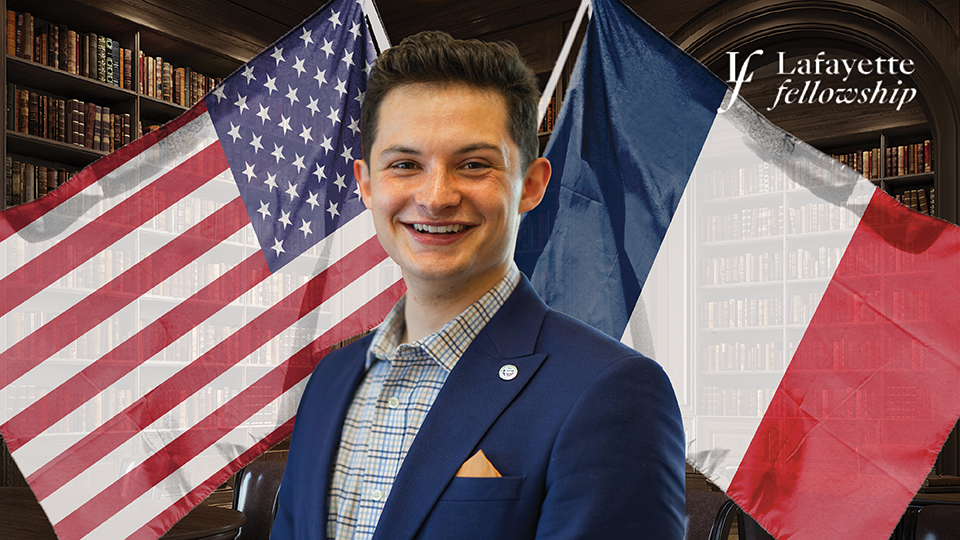
has been accepted as one of the first scholars in the inaugural year of the Lafayette Fellowship. The program is presented by the French Embassy in the U.S. in celebration of the
French-American friendship and the 250th anniversary of the American Declaration of
Independence. As a fellow, Kamman will pursue one year of fully-funded master’s study
at Aix Marseille University, one of 15 leading French universities while participating in an immersive leadership
and cultural program designed to cultivate the next generation of French-American
leaders.
“I get to go to Dr. Alain Aspect's school and learn from scientists — potentially
him — about the very topics I'm interested in,” Kamman said. “The benefits of the
Lafayette Fellowship really lie in the mentorship, the community I get to become part
of and the fulfillment of a childhood dream to participate in the academic circle
and community of my role model.”
Opportunities and open doors
After learning about Alain Aspect during his seventh-grade social studies class, Kamman’s
next stop on his journey to becoming a physicist was a visit to Fermilab's National
Laboratory.
Kamman said that Fermilab is the second-largest particle accelerator in the world
and was designed so the general public could learn more about scientific research
conducted by the federal government.
One of Kamman’s high school physics teachers, Joanne Bader, sponsored his attendance to “Sunday Morning Physics” lectures at the lab, and these talks immediately sparked
Kamman’s imagination. At this point, he wasn’t sure what a career in physics might
look like, but he knew it was the place for him.
He likes to joke that originally, he didn’t want to go to K-State, but his mom suggested
he visit campus anyway.
“I spent the entire drive complaining; I thought I was heading into the middle of
nowhere,” he said. “Growing up in suburban Chicago, I’d barely seen cows before. Then
I got to campus. I remember walking around and thinking, ‘I actually like it here.’
But I didn’t want my mom to know, because I knew I’d never hear the end of it. So
I spent the entire visit pretending I hated it while secretly loving it.
“The people are nice. The architecture is stunning. I loved the Honors House, where
I lived for my first few years on campus. The community felt welcoming, and the research
opportunities were fantastic.”
He started conducting research at K-State during his freshman year and worked alongside
Dr. Loren Greenman for four years exploring theoretical computational molecular dynamics. His first
national grant was through the National Science Foundation Research Experiences for
Undergraduates program, which he completed at K-State the summer between his sophomore
and junior years. He also was active in student government during his time on campus,
serving as a representative for the College of Arts and Sciences and justice of the Student Tribunal.
“I arrived as a somewhat naïve freshman, not knowing much about the world and thinking
I had everything figured out,” he said. “And then I grew a lot from the intellectual,
ideological and social exposure to new ideas, lessons and people. My ideas were challenged
in a constructive and supportive environment, and that helped me grow.”
For him, the K-State experience opened doors and introduced him to opportunities he
might not have been able to pursue at other institutions.
“I wouldn't have been able to get two degrees and two minors at any other school,”
he said. “I would not have been able to be in student government like I was while
doing the physics club, while doing research. I could not have done all of that at
another university.
“K-State’s greatest asset is that it has opportunities for students that an Ivy League
would have. But unlike some of those elite schools, the culture is not unhealthy competitive. It wasn't people clawing and pushing each other down to be the first one to get
the opportunity; it was everyone lifting each other up, boosting each other to get
other people to where they needed to be. We're all just one giant team, which is really
cool.”
Finding a focus
Kamman credits Beth Powers — director of scholar development and undergraduate research at K-State — for helping
him focus his diverse interests into a career path.
“I was originally applying for the Rhodes and Marshall scholarships before deciding
to focus on Fulbright,” he said. “I remember sitting in her office talking about all
these interests I had.
She asked, ‘Why do you want to do this?’ I said I didn't know, but she kept pushing
me. Finally, she asked, ‘What is your fight against the world?’ I just sat there thinking
about it. And that's when I first said it. I remember I said, ‘I want to stop the
abuse and misuse of science and technology.’ She immediately said, ‘Great. Let's work
with that.’
“Ever since then, she's helped guide me along that path. I think that was the first
time I even realized what I wanted to do. I had all these separate interests, and
she helped me connect them and find the nexus point.”
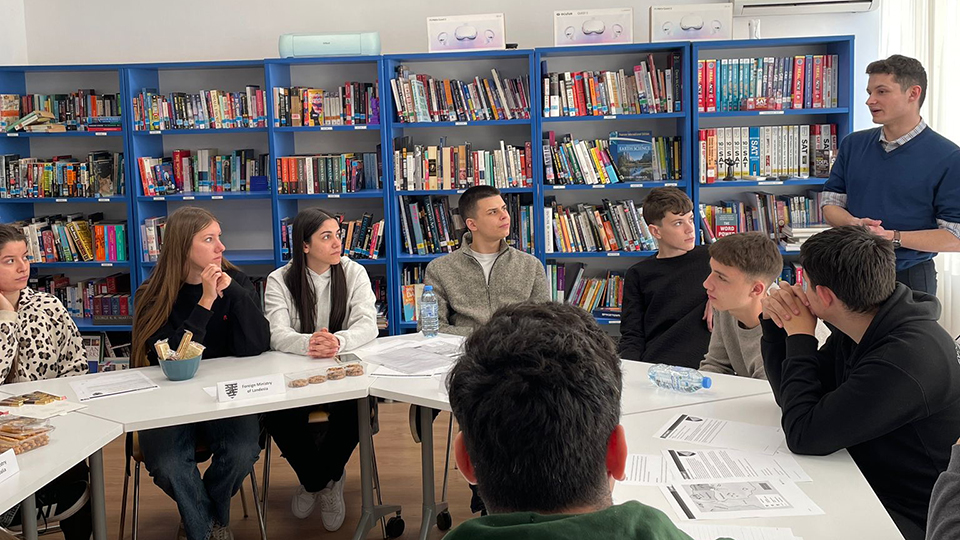
Kamman is currently living in North Macedonia for his second year as a U.S. Student
Program Fulbright fellow. The U.S. Fulbright Program promotes international education
and cultural exchange, offering students and scholars the opportunity to study, teach
and conduct research.
As part of the program, he serves as an English teaching assistant and has guest lectured
at the University of Zagreb in Croatia on cybersecurity. He tries to incorporate physics
and K-State connections whenever he can.
He also created a diplomacy simulation program for high school and university students.
Twice a month, he helps conduct simulations similar to Model United Nations, where
students represent different stakeholders and work through scenarios. Examples include
responding to a simulated Ebola outbreak, or illegal wildlife poaching and tracking,
where invited K-State professor Justin Kastner ’98 and K-State student Shillelagh Kentner to discuss veterinary science and the One Health approach via Zoom.
“I ended up copying a lot of K-State’s pedagogy,” he said of his work as a teaching
assistant. “I’d think, ‘We did this event at K-State. Let’s try it here. K-State prepared
me by giving me opportunities to grow. I could look back and recognize how those experiences
shaped me and my friends, then try offering similar opportunities to students here.
I basically tried bringing the K-State experience to the Balkans. I’ve tried to bring
little pieces of K-State culture with me. I taught them Go ’Cats/the Wildcat handsign,
showed them campus on Google Earth and introduced them to K-State programs.”
Exploring the intersection between physics and ethics
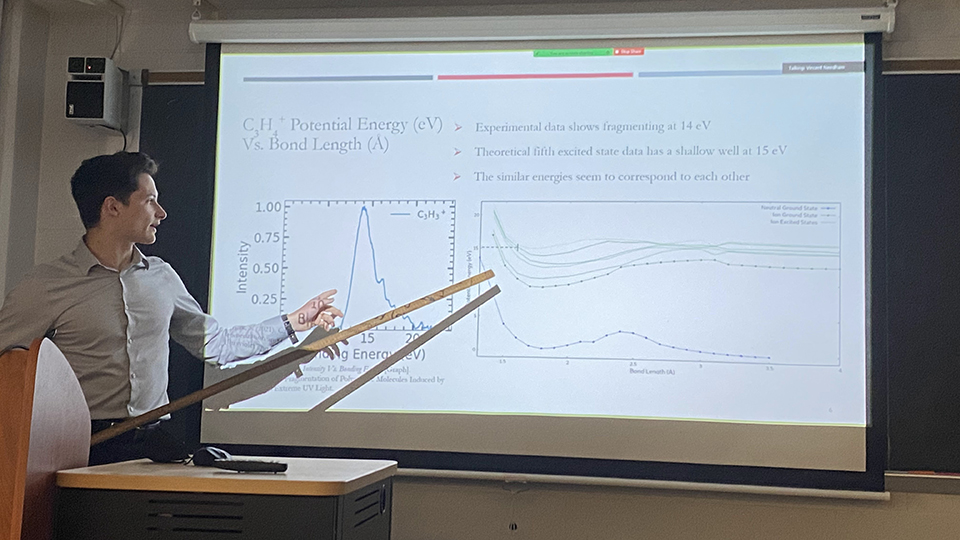
Kamman’s current line of study was sparked through a physics course at K-State, where
he began to ponder how scientific research can be weaponized and what physicists can
do to prevent that.
“I remember feeling slightly alarmed that what I was learning in class was being used
in ways I was watching unfold around the world,” he said. “I watched drone strikes,
missile attacks, the weaponization of infrastructure and debates around nuclear power
plants being used as shields for military assets. I started thinking, ‘OK, this is
a problem.’ But even then, I didn't know there was anything I could do about it.”
Through mentors during his time at K-State, he learned about the Physicists Coalition
for Nuclear Threat Reduction, based out of Princeton University. He is now a member
of the coalition, joining other physicists in advocating for the responsible use of
technology.
“When people think about physics, they don't usually think about policy or politics,”
he said. “They think about people hiding in a basement doing research, which, to be
fair, I did do. But I was surprised by how much people respected what I had to say
and genuinely listened.”
Kamman said he is thrilled to have a chance to spend more time exploring ethics and
physics through the Lafayette Fellowship. He is one of only 30 scholars selected for
this fellowship, out of the approximately 3,500 who applied.
“There aren't many scientists in politics, and I don't want to be a politician,” he
said. “I have two very different fields that overlap; it's very difficult to find
someone in that space. Being able to have that is reassuring. I know I'll meet someone
who does what I want to do and who can help guide me by explaining their path so I
can better set my own trajectory moving forward.”
As for where his life will take him after the Lafayette Fellowship? His goal is to
pursue a doctorate degree and then eventually end up at NATO’s science and technology
organization.
“As technology develops and grows, it becomes increasingly intertwined, so our military
and civilian technologies are blending together,” he said. “Unfortunately, that means
civilians are more in the line of fire than ever. I’d like to work within NATO to
help fortify civilian infrastructure against potential military attacks. The technologies
my generation develops should help people, and I think that’s what we should use them
for.”