
How two K-State professors are helping students level up learning and community through The Game Lab



By Ashley Pauls
K-State Alumni Association
When Bradley Burenheide ’06 walks into work in K-State’s College of Education early
in the morning, sometimes he’ll pop into The Game Lab and discover students are already
there, taking a moment to hang out and play games before classes.
The lab is a dedicated space on campus for tabletop gaming — a hobby that encompasses
board games, card games, miniature-based games, and roleplaying games such as Dungeons
and Dragons. Despite the students’ busy schedules, they’re drawn to the lab, not just
because they enjoy gaming, but because of the camaraderie and friendship they find
with the other students gathered around the table.
And that, according to Burenheide and co-director Seth Lickteig ’07, ’17, ’20, is
what The Game Lab is all about.
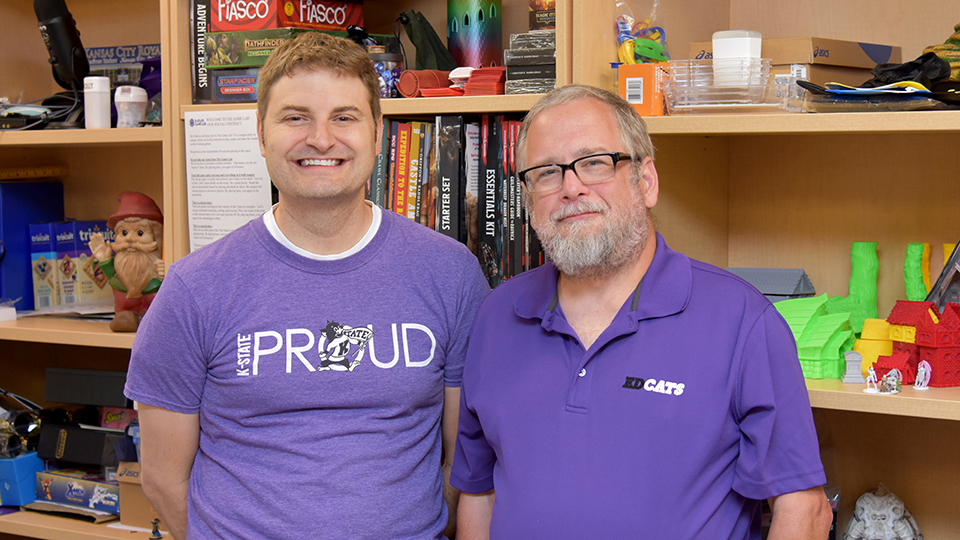
Burenheide and Lickteig, both professors in the College of Education, founded the
lab three years ago as a space where students can play games in person and also where
academics can study/research how games impact the educational experience.
“The beautiful thing about The Game Lab, we've enabled kids to find their tribe,”
Burenheide said. “They have found not only kindred spirits, but they have found people
they can trust, confide in. It was something that has been the most pleasant of surprises,
the relationships that form. We are now a permanent stop on any recruiting tour. You
can tell right away when they stick their head in this room, and they go, ‘I'm home.’”
Bringing the dream to life
Burenheide is an associate professor and earned his doctorate in curriculum and instruction
from K-State. Lickteig is a teaching assistant professor and earned a bachelor’s in
social studies education and a master’s and a doctorate in curriculum and instruction.
Burenheide previously served as Lickteig’s K-State academic adviser, and the two quickly
bonded over their love of tabletop gaming.
“I remember Seth saying, it would be so awesome if there was a place where you could
study games and play games and have fun with kids,” Burenheide said. “And we both
just kind of dreamed about it for a while.”
Lickteig’s career took him away from Manhattan for a season, but he eventually found
his way back. And one of the first things Burenheide and Lickteig began to discuss
as new colleagues within the College of Education was developing a space for gaming
at the university.
They began organizing gaming sessions in their free time, and excitement continued
to build as more and more students started attending. Burenheide and Lickteig eventually
approached their department chair about creating The Game Lab, and they formally launched
the project in fall 2023. They moved to their current location in the basement of
Bluemont Hall a year ago, and Burenheide and Lickteig can’t wait to watch how the
program continues to grow.
“It’s only just starting to scratch the surface of what it could be,” Burenheide said.
Promoting learning through games
Lickteig, who previously served as an eighth grade teacher at Fort Riley Middle School,
wrote his dissertation on the classic fantasy-based card game Magic: The Gathering.
“My research is in, what happens if we play the same game over and over again? I would
imagine that the players will learn how the game functions, and games themselves are
great for learning, and that it allows you a safe space to try new things, especially
on repeated playthroughs,” Lickteig said. “What we talk about with games is that it's
all about decision making and resource management. Most games include those as their
hallmarks, and so when we do our research into games, that's what we're trying to
articulate, especially for non-gamers, what kinds of thinking games require people
to do, and we would argue that kind of thinking is very good thinking, and it's the
kind of thinking that's hard to teach in typical classrooms. And it's also the kind
of thinking that we need in the 21st century.”
Lickteig said one of the most important parts of being a teacher in the classroom
is keeping students engaged, and games can play a role in that.
“If the kids are passionate about it, they're going to be more invested in the activity
too, and the moment will have more power,” Lickteig said.
When you hear the word “games,” many people think of classic board games like Monopoly,
Sorry! or Risk. However, the gaming industry continues to expand, with more recent
hits such as Ticket to Ride and Catan. New games cover a variety of themes, topics,
play styles and stories. Some are competitive, but some are cooperative, encouraging
players to work together to accomplish a goal.
“In a game you are part of the story,” Lickteig said. “You are part of the action,
and so if it's a collaborative game, teaching kids how to communicate, how to take
a back seat, how to share the spotlight. We are doing these things, not just with
middle school, elementary and high school students, but we're also working on this
with our undergraduates.”
Another goal of The Game Lab is to encourage students to make in-person connections.
Gaming is a way to form friendships, and one of the things that has impressed Lickteig
about the students is that they will linger at the lab, even after the game is over,
asking himself and “Dr. B” questions and just generally chatting about life.
“It's amazing how a game can bring people together,” Lickteig said. “If it's engaging,
they put these devices aside, and then all of a sudden it's like, I don't care what's
going on in Instagram, I care what's going on here in our game. Because we're agreeing
to be in this moment together. It's just amazing to see adults interact that way,
because you don't see it anymore. Walk into a university hall and see how many people
are on their phone.”
Expanding outreach to the community
K-State’s Game Lab is fairly unique amongst its peer universities.
When Burenheide and Lickteig were initially conducting research, they found examples
of digital/video game labs and a few institutions that had mini game libraries that
students could utilize. However, Burenheide and Lickteig were dreaming of something
bigger: a place where students could not only play tabletop games, but where academics
could study how games improve learning.
They’ve had a chance to present their research at Gen Con, one of the largest tabletop
game conventions in the world, and they plan to attend again this summer with a group
of students. They partner with The Village Geek, a local game store in Manhattan,
Kansas, and have also worked with the local school district, USD 383, to host STEM
nights and Dungeons and Dragons clubs. They’re also helping to promote a local board
game convention called MHKardboard Con, taking place this fall.
They operate the Games in Learning and Teaching academic journal, and starting this fall, they will be introducing an online master’s
program on game-based learning. The program will explore the theory of games, the
philosophy of play, and game design for the classroom. They’re also planning to offer
a game studies certificate for undergraduates.
Why K-State feels like home
Both Burenheide and Lickteig are grateful for a chance to give back and support students
at an institution that’s close to their hearts.
Burenheide ended up at K-State after working as a classroom teacher for a decade,
when he decided to pursue his doctorate. He served as a graduate teaching assistant
in elementary social studies, and he fell in love with the campus.
“It was special. It was challenging in the best possible way, and I pushed myself
through the program as hard as I could,” Burenheide said. “I was very fortunate that
year that I completed my doc, they were looking for a secondary social studies professor.
I was very fortunate to get the position, and I have not looked back since. I have
said I'm going to retire here, and it is just as wonderful as it gets. It's a special
place.”
Both of Lickteig’s parents are K-State grads, and he remembers attending K-State football
games growing up. Although he started out studying computer science and engineering,
he decided to switch to education, inspired in part by his mom’s experience as a teacher.
He spent some time teaching at Emporia State University, but then he and his wife,
Amanda Graham Lickteig ’07, ’12, ’15, were able to find positions at K-State.
“We always had hoped that we would come back to K-State eventually, and so when that
window opened, it was great,” Lickteig said. “And we've been so happy to be back.
It's nice to be back in Manhattan and seeing familiar faces. It just feels like home.”
If you’d like to learn more about The Game Lab and how to support its mission, email
gamelab@k-state.edu.