
Making an ‘immediate impact’: Karla Hagemeister ’97 supports food security as executive director of the Flint Hills Breadbasket



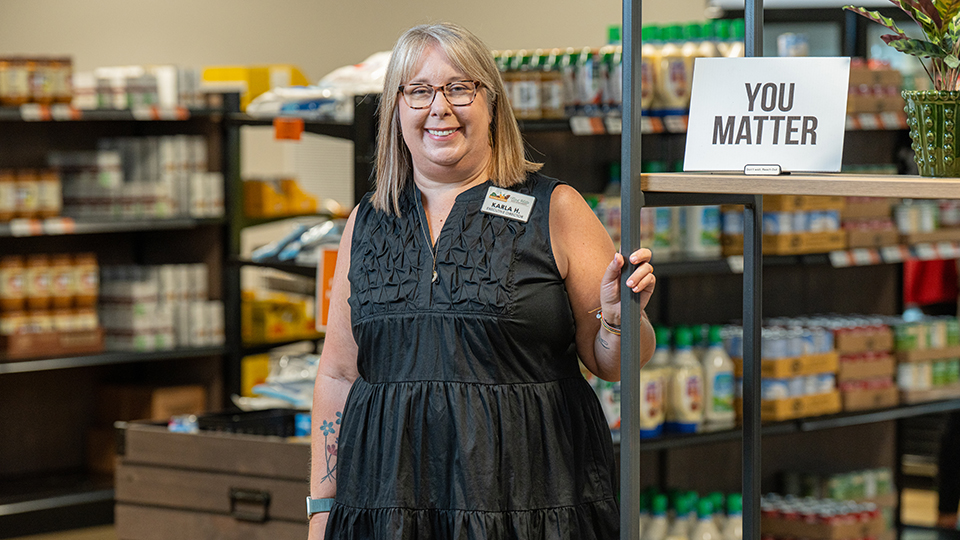
By Ashley Pauls
K-State Alumni Association
Karla Hagemeister ’97 still has fond memories of the instructors who mentored her
during her time studying social work at K-State. And thanks to her current role as
the executive director of the Flint Hills Breadbasket, she still gets to see one of
those retired instructors, who is now a volunteer at the community food pantry.
“I just love how full circle that is,” Hagemeister said. “She was part of my development
as a social worker, and now I get to support her in her fun job as a volunteer.”
Hagemeister, who also earned a nonprofit leadership certificate from K-State in 2025,
is a dedicated advocate for the Flint Hills Breadbasket, which is now located at 2326
Skyvue Lane. The organization has served the Manhattan area for more than 40 years,
and was recently selected as this year’s beneficiary of the annual K-State Homecoming Philanthropy 5K Run/Walk.
Hagemeister said her favorite part of her job is “the people I get to see every day
— whether it's our volunteers or our guests or community members that are just stopping
by, our business partners, anything like that. I like the fact that the work we do
has an immediate impact on making somebody's day, their life, their outlook better.”
Promoting food security
Prior to the Breadbasket, Hagemeister dedicated more than 20 years to community social
work, first for the Kansas Department for Children and Families, and then through
victim services for the Riley County Attorney’s Office.
When she heard in 2022 that the director of the Flint Hills Breadbasket was retiring,
she was immediately intrigued.
“I'd been around in the community for a long time and served on nonprofit boards and
lived and worked here,” she said. “My husband and I both went to K-State and stuck
around. I was aware of the Breadbasket and its strength as an organization. This was
just a great opportunity to support an organization that I knew was really important
to our community.”
The Breadbasket operates as a community food security program.
“We are the primary organization within our community that addresses food insecurity,”
Hagemeister explained. “So we are a food pantry here on site, but we also support
seven other pantries here in the community with food. We are that collection point,
and then we help push it back out again.”
Another important piece of their mission is connecting community members with other
support services beyond the food stocked on the pantry shelves.
“Many of our community members have complex needs and goals,” Hagemeister said. “How
do we help them connect with other programs in our community that are doing great
things and can help them with filling in those other gaps? I don't need to replicate
it. I need to get them connected. And then that last piece for us is empowering our
guests to meet their own basic needs. I'm not here to be a gatekeeper or a judge or
anything like that of what brings somebody through the door, because everybody's experience
is different, and there's a lot of complexity in people's lives. But how do we build
relationships with our guests to help them decide, ‘OK, this is what I want to do,’
and we are building them up to empower them to do those things.”
Meeting campus and community needs
Hagemeister said that K-State students do utilize the Flint Hills Breadbasket food
pantry.
“I would say that we are more likely to be serving a graduate student population,”
she said. “Their needs are a little bit different than the single 21-year-old college
student who maybe has a dining plan or is living on their own with roommates, as opposed
to a student who is further along in life and maybe has a spouse or kids.”
The organization works in partnership with Cats’ Cupboard, K-State’s on-campus food pantry. Depending on a student’s needs or schedule, they
may visit one or both of these pantries.
“There's a whole lot of crossing paths because we're meeting the student need,” she
said. “We're meeting the needs of the person coming through the door. The fact that
our guests feel that they're welcome, that it's a warm place, that there's a lot of
dignity assigned and held with the fact that somebody is visiting our services, really
makes my day.”
Making a difference through mentoring
Hagemeister said that one of the best things that K-State taught her about leading
an organization is the importance of strategic, thoughtful decision-making. It’s not
about making a decision that merely “feels good” — it’s about understanding why an
idea would or would not work, determining what direction an organization needs to
take, or how to provide leadership through a period of change.
Her goal as a leader is to strike the right balance between honoring the organization’s
history, meeting needs in the present, and planning for the future.
“As the leader of a nonprofit, you're in charge of maintenance, IT, payroll, your
actual services, your HR. You're in charge of all of it as a small organization,”
she said. “I was really fortunate to have a great group of peers here in the community
of other nonprofits, but also some good, strong allies at K-State. Some of those instructors
that I had, maybe I'm not in their classes anymore, but I still have their email address
and they still have mine, and so they're still a resource to us. I think that's a
great thing.”
Hagemeister also enjoys giving back to current students by hosting interns and serving
as a mentor.
“I've had social work interns, business interns, communications interns, leadership
interns. I've had interns from all different departments at K-State,” she said.
How to help your own community
Regardless of where you live, Hagemeister encourages K-Staters to look for opportunities
to volunteer at, or learn more about, their local food pantry.
“Something that I think is really accessible to everybody is to learn about food insecurity,”
she said. “Dig a little bit deeper into what some of your assumptions might be, into
why people are experiencing it, or what their stories are, and what the policies are
at the local, national and state level that impact why a family might be experiencing
food insecurity. There's a lot of conversation around SNAP and Medicaid and changes
to those programs, error rates, all those sorts of things. And I think it's really
important that we step out of what we think we know, and just have a sense of curiosity
to understand what those programs are truly like, as opposed to the picture we might
have in our mind.
“The need for food is universal. Every community has some sort of program that is
trying to make sure that people have access to healthy food. And so, what does it
look like in a different community? It’s a great thing to dive into and to learn about
and see how a person can impact their own local community.”
Learn more about the mission of the Flint Hills Breadbasket.