
The K-Stater’s seventh editor shares memories of Hollis House, pasting together layouts and more



By Tim Schrag '12
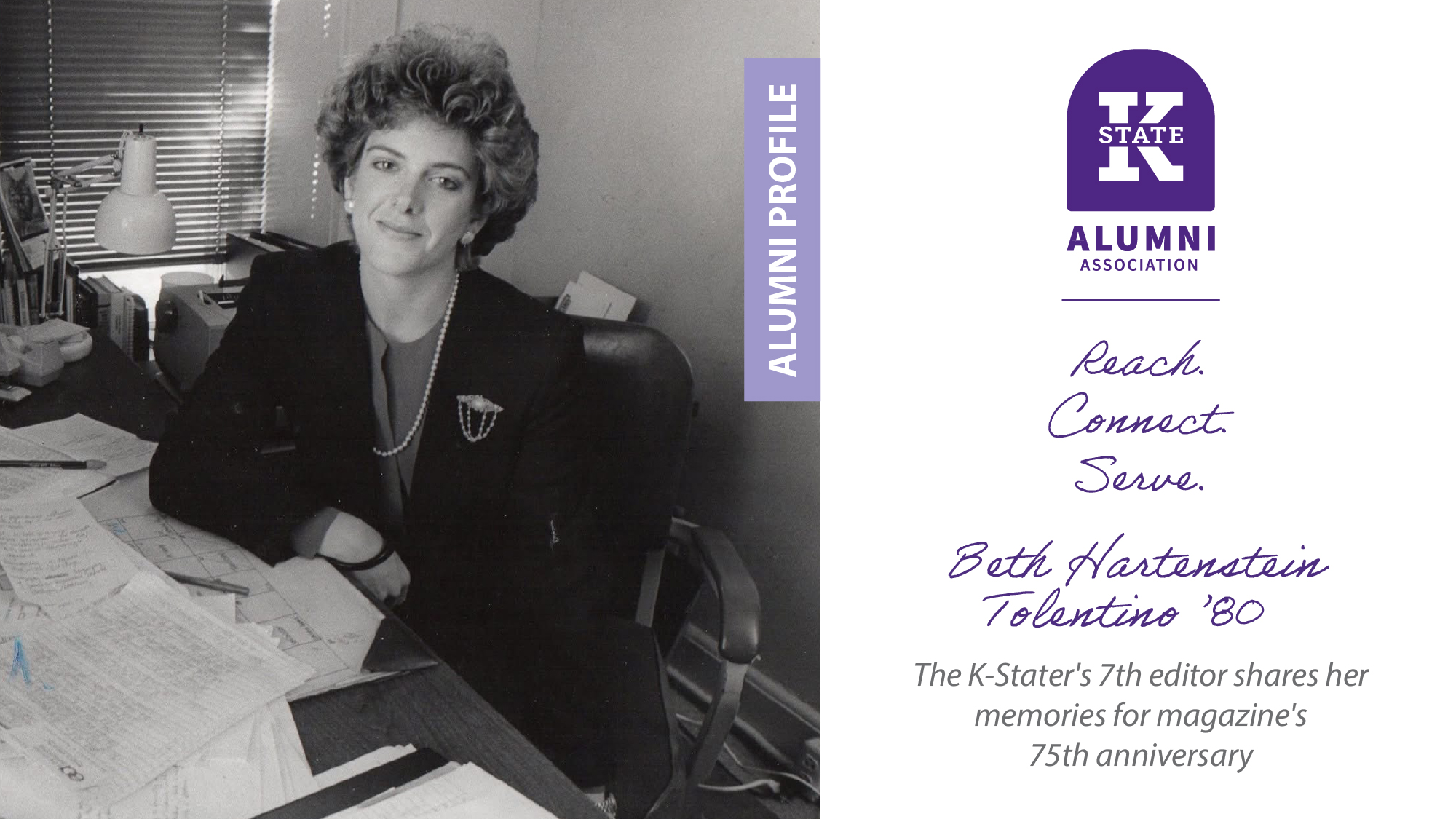
In 1983 Beth Hartenstein Tolentino ’80 saw an ad in the corner of the latest K-Stater magazine.
“They were looking for an alumni editor,” she said. "That sounds interesting. I’ll apply. I could not believe I got an interview.”
Tolentino was working as a farm reporter for the Grand Island Daily Independent at that time. She drove from Nebraska to Manhattan through a snowstorm to interview with the K-State Alumni Association’s executive director Larry Weigel ’68, ’69. In March of that year, she became the magazine's seventh editor.
The Association was headquartered at Hollis House – located where Throckmorton Hall now stands – and the staff was much smaller. They shared the space with the KSU Foundation. Tolentino recalls working alongside Amy Button Renz ’76, ’86, Grace Prusik and Jeanine Lake on the top floor of the building.
“I loved that old building, and we used to get squirrels in the building, especially in the storeroom and there was always craziness with the staff,” she said. “I can remember doing an all nighter there with Marcia Jensen one time to get the magazine out.”
While Tolentino was editor, the K-Stater came out six times a year. Each issue had 28 pages of campus updates, 2-3 feature stories and, of course, class notes. Pages were laid out by hand and designed on boards using scissors and paste. In 1986 the magazine would expand to 32 pages and feature the first internal color pages. Tom Carlin, ’72 the K-Stater’s sixth editor, was working for the KSU Foundation and was always available if she had a question or needed help.
“Back then we would take our stories to a place that would type them out and print them in columns and then we would literally paste it, either with rubber cement or we were really uptown when we got a wax machine so you could wax it. That was a lot easier because you could change things around,” she said.
The boards would be delivered to Topeka where the K-Stater would be prepared for printing.
“I would get in the car and drive these big double page spread paste ups in the car along with pictures, the actual photographs that they had to prepare,” she said.
The printers would then take pictures of the layouts and turn them into a negative which could then be adjusted and used to make and print the pages of the magazine.
In addition to her duties with the K-Stater, Tolentino also helped produce all of the Association’s communications from printed materials like posters to invitations and more.
Tolentino recalls telling the story of a new football coach named Bill Snyder.
“He was a little camera shy and didn’t really want a lot of press,” she said. “But Jon Wefald was the president at the time and encouraged him to let us do a cover story. So I met him in the office up there at the football stadium. I tried to make it as quick and painless for him as I could.”
In 1993, Tolentino went to part time and took the role of the K-Stater’s assistant editor. Tim Lindemuth ’77 succeeded her as eighth editor. During this period, Tolentino recalls the K-Stater underwent major changes brought on by technology, including desktop publishing and other advancements.
“Tim is so sweet,” she said. "He really shaped the magazine. It was his joy and still very much is his joy.”
Tolentino would stay with the Association until 1999, when she shifted to a career in healthcare. She would go on to become a physician assistant in 2004.
“It was a big change, but I always said when you’re a journalist and when you’re in healthcare, you have to be able to know where to go to find answers, keep your mouth shut and be accurate,” she said. “Those skills transferred over to being a physician assistant and my handwriting has never improved.”