
Paws, purpose and purple pride: How Susan Nelson ’89 is helping train the next generation of veterinarians



By Ashley Pauls
K-State Alumni Association
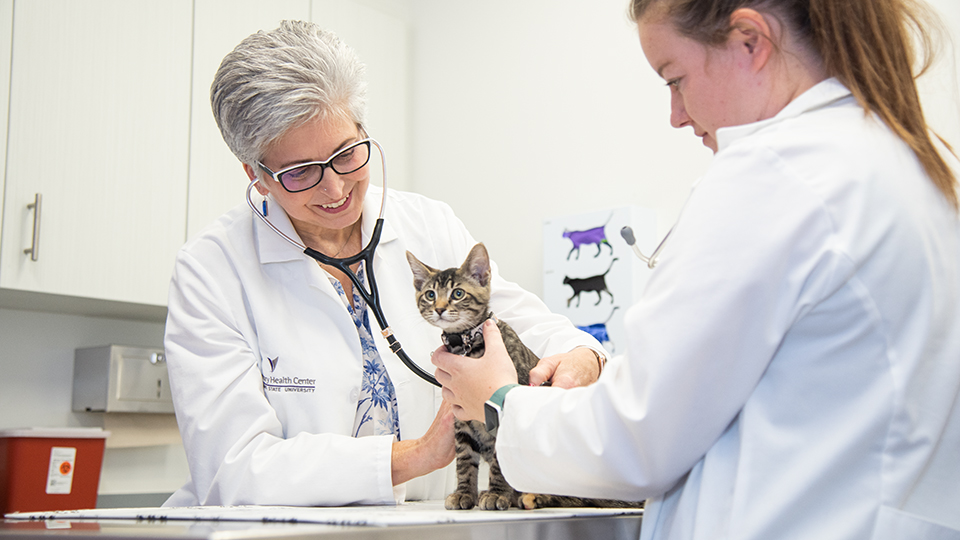
 Susan Nelson ’89 spends a good portion of each day thinking about cats. Not only is
she a pet owner, she’s also a Cat Friendly Veterinarian certified by the Feline Veterinary
Medical Association. Finally, as a K-State grad and clinical professor in the university’s
Veterinary Health Center, she’s a proud Wildcat herself.
Susan Nelson ’89 spends a good portion of each day thinking about cats. Not only is
she a pet owner, she’s also a Cat Friendly Veterinarian certified by the Feline Veterinary
Medical Association. Finally, as a K-State grad and clinical professor in the university’s
Veterinary Health Center, she’s a proud Wildcat herself.
In honor of International Cat Day on Aug. 8, we asked Nelson to share more about her
own journey to become a veterinarian, and how K-State trains new vets to provide expert
care for cats.
“We're proud of our school,” Nelson said. “We try to teach and provide a good education,
and most of our students come out with at least two job offers at graduation, so they're
usually highly sought after. Some vet schools do tracking, where you're only going
to focus on small animals or you're going to only focus on horses or large animals.
We still have our students learn about all the species, which is actually quite difficult.
So, we are able to send some well-rounded students out to the job market.”
Coming to K-State
Nelson knew from early on that she wanted to become a veterinarian.
“I literally was about 5 years of age,” she recalls. “I grew up in a small town and
had a neighbor who was a veterinarian. One night he comes over and asks my dad if
he could help him with a C-section on a cow. So, the family tagged along with them,
and I remember watching that and thinking it was so cool. I've always liked sciences,
especially biological sciences, so I knew I would do something involving that area
of study.”
Although Nelson did look at other veterinary schools, since enrollment can be very
competitive, K-State was always her No. 1 choice. She was already familiar with the
school’s strong reputation, and it was close to her childhood home in Nebraska.
“I've always had a pretty decent work ethic, but veterinary school pounded that in
even more,” she said of her experience at K-State. “It doesn't matter how well you
did in undergrad, there's always more studying to do when you enter vet school, as
you take a lot higher case load. School was hard, but I also enjoyed it.”
Nelson said she was immediately drawn to the sense of community and camaraderie at
K-State, and she is still in touch with many of her classmates.
“When we come back for reunions, you just start right back up from where you left,”
she said.
Nelson worked as a veterinarian in private practice in the Manhattan area for 14 years
before beginning her career at K-State.
“They wanted veterinarians like me who had been out in private practice and could
talk to the students about what it's like to work in that type of setting, but still
be able to teach in the setting of a teaching hospital,” Nelson said.
Providing education and quality pet care
K-State’s Veterinary Health Center not only provides medical care for animals in the
community, veterinary students have an opportunity to learn necessary skills in real
time as they work alongside professional clinicians.
“Veterinary medicine in general, there's always something new,” Nelson said. “I mean,
you can be a veterinarian for your entire life and you're still going to see something
new on a regular basis, right? So that's always exciting, and working with the students
is exciting as well. It’s really great when you see that light bulb go off and they
have their ‘aha’ moments, or when they're practicing their technical skills and they're
able to do something, especially for the first time, when they thought maybe they
couldn't do it.”
Although students are often inspired to pursue a career in veterinary medicine by
their love for animals, having strong people skills also is important for a veterinarian,
Nelson said.
“A lot of us come to vet school going, OK, we want to work with the animals, but we
kind of forget sometimes that they come with an owner attached as well. Learning client
communication and how to also treat the client is just as important, because they're
worried about their pets. If there's something serious going on with their pet, being
able to walk the client through that and help them navigate through the situation
is equally as important as treating their pet. Some of your first exposures to having
those kinds of conversations happens when you're in vet school.”
Another lesson K-State seeks to teach aspiring vets is the importance of giving back
to the community.
“We have a lot of good programs and community outreach,” Nelson said. “Our shelter
medicine program is awesome, as students get to spay and neuter a lot of cats and
dogs in our area and many surrounding communities. Students learn necessary hand skills
and associated muscle memory needed to handle the surgical instruments. Once learned,
this creates the foundation that will allow them to perform other types of surgeries
in the future. It is also a win for the communities, as it helps to decrease the unwanted
dog and cat population. I can always tell when they come through our rotation that
they've already been on the shelter med rotation, as they are much more confident
about their surgical skills.”
While working with Nelson, veterinary students learn how to read cat behavior and
how to safely handle a cat to avoid getting bit or scratched, and in a manner that
is the least stressful for the cat. One has to keep in mind that methods that work
for a dog may not work for a cat.
“There is an old saying that cats are not small dogs; they have a totally different
physiology,” Nelson said. “They have nutritional needs that dogs don't require for
certain vitamins and amino acids, etc. They are quite unique that way. Some medications
a dog can take with no problems can be fatal for a cat, and vice versa. So, veterinarians
have to know those differences.”
Looking to adopt a pet of your own?
If you’re interested in adopting a cat, as with any pet, it’s important to do your
research ahead of time so you can successfully meet your new pet’s needs.
“They need to have the necessary supplies,” Nelson advises. “Cats do need a litter
box. Some can be very picky on the type of litter box or the type of litter. Usually
having more than one box is not a bad idea, even for one cat. Make sure they have
food that's nutritionally complete and designed for their life stage.
“Cats are also creatures of habit. They actually don't like their boat rocked very
much. They need their own space to get away from other cats, pets and people at times;
even a cat who's a sole cat in the household needs a place to go, a private place
where they can sleep and be alone for while, and then they'll come out and be social
again. Just like us, they need alone time sometimes. Along with personal space, there
should be multiple food, play and litterbox areas as well, especially if there are
multiple pets in the house, so a cat always has access to these important things that
contribute to its physical and mental well-being.”
Learn more about K-State’s Veterinary Health Center.