
Top ’Cat in Kansas’ largest city: Wichita city manager says role is a great professional challenge



By Tim Schrag '12
Editor's note: This story originally ran in the fall issue of K-Stater magazine. Members of the K-State Alumni Association can read more exclusive content like this in each issue.
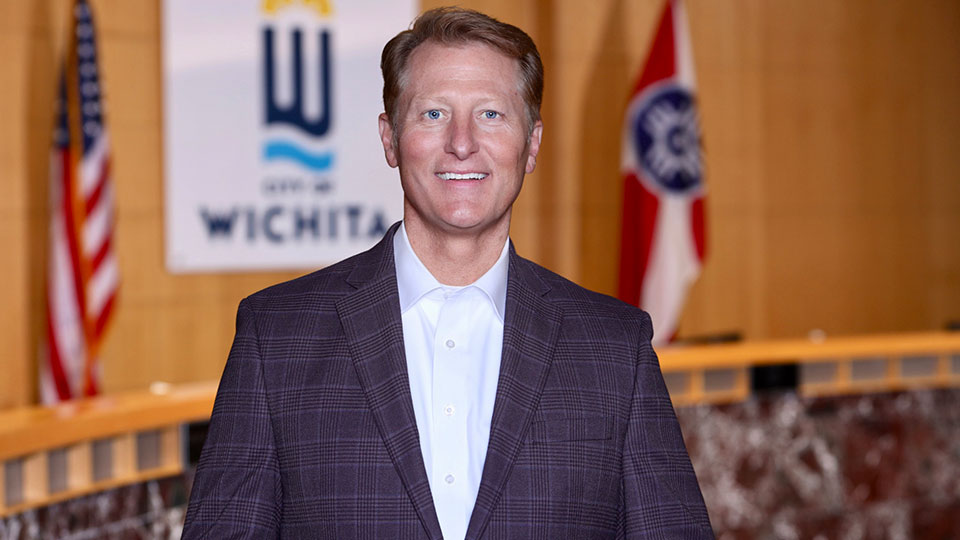
With almost a year under his belt,Dennis Marstall ’91 is adjusting to life in Wichita.
Wichita’s newest city manager has nearly eight meetings a day, connecting with a wide variety of people, departments, constituencies and partners.
His favorite spots are the downtown areas near the Arkansas River (which in Wichita is pronounced Ar-Kan-Zus not Ar-Ken-Saw).
“Look at our peers in Oklahoma City, Tulsa, Kansas City, Omaha, Des Moines: we all have rivers,” he said.
“Who develops those and capitalizes on those, I think will be the thriving cities going forward, because it’s a natural asset. You’ve got to take advantage. And so that’s one thing that struck me when I came here during the interviews was what an asset it is that I don’t think we’ve activated it enough.”
This spring Marstall attended his first Riverfest. He’s come to learn of the east/west dynamic of the city. His QuikTrip order is a brisket breakfast taco. He’s also found several barbeque spots he likes, but he’s still searching for the right breakfast chicken biscuit.
“It is a big small town where people really know each other,” he said. “It’s easy to make connections. People have generations and roots her, and people love it. They move here and don’t leave.”
Marstall became city manager on Dec. 31, 2025. In this role he oversees the daily operations of the Air Capital of the World. He manages a budget of $770 million, leads a workforce of roughly 3,400 employees and is responsible for carrying out the vision and strategic plan of the Wichita City Council.
“It’s everything I thought the job would be,” he said. “And the community’s been wonderful and being a top 50 city in population, it is certainly a great professional challenge.”
He has a long career in public service, having served in multiple roles with the city of Charlotte, North Carolina; vice president with United Way of Greater Charlotte; assistant city manager for Manhattan, Kansas, where he played a key role in municipal operations and strategic initiatives in the Little Apple from 2019 to 2021; and county administrator for Lancaster County, South Carolina.
Marstall grew up in Manhattan and earned a degree in political science from K-State. He also earned a Master of Public Administration from the University of Louisville. As a K-State student, he served as a K-State Student Ambassador in 1990, a member of Student Alumni Board and the Union Governing Board. He joined Theta Xi fraternity and remained very involved with the national organization. After graduation, he worked for the organization and ultimately served on its national board of directors, becoming national president from 2011-2014.
Marstall said his K-State connections seem to resonate well in Wichita and serve as a great ice breaker.
“Even when I did the interviews, we had a very public forum at one of the venues here in December, and I just mentioned my background, ‘so I’m a graduate of K-State,’ half the room applauded,” he said.
To get better acquainted with the community and the city staff, you’ll find him out in the community meeting with leaders and everyday citizens. He’s participated in ride alongs with first responders, the public works teams running snowplows, and others. Nearly every day brings a bit of learning about his new home.
“I want to be with every position,” he said. “It’ll take time to some degree, because it’s important, I think, for people to see the leader knowing what equipment they are working with, what their facilities are or their environment is, and what the overall kind of conditions they have to work in. And I think people appreciate that. And so that’s always been my approach. It just takes a little bit longer to get around to more folks and more departments.”
Marstall has observed what he calls the “Wichita Welcome” up close and personal, but noted the city doesn’t brag enough about what it has to offer.
“I think that’s important to continually tell that story, because no one else is going to,” he said.
Beyond being the largest city in Kansas, Wichita has a robust economy driven by aviation and agriculture. It’s home to approximately 401,000 Kansans, 16,489 of which are K-State alumni and friends. It also has a rapidly growing arts scene.
“The entrepreneurial spirit is here,” he said. “If you go back and look at what was started here, everything from Pizza Hut and Freddy’s to Coleman, Cessna and Beechcraft. There is such an entrepreneurial spirit here that I think is really being rejuvenated. We have a lot to work with and a lot to build on.”
The city staff, Marstall said, has a wide range of experience and certifications, making it uniquely skilled to meet the needs of its citizens.
“We’ve got a great team,” he said. “A lot of them are K-Staters, and they all just want to do a good job and put in an honest day’s work for an honest day’s pay.”
They, along with the city council, are actively looking at ways to improve city services and quality of life; an example of this would be how the city recently made investments in roads and sidewalks.
Marstall said the water supply, public safety and transportation infrastructure are some of the key issues facing Wichita and how those issues have impact and spillover into surrounding communities.
“We are often thinking about our role in the region and how we can all work together just for everyone’s safety and benefit,” he said. “It does take a lot of thought and intentionality about what do we need assistance with? How can we help here? Our county, state and federal partners can have a big impact on us. There’s a lot to put together and I see everything as a puzzle or putting the pieces together in equations. We’ve just got to put one number here and take a number there and put the equation together and you’ll get it figured out.”
As Wichita continues to grow, Marstall hopes to focus on how to enhance the city.
“We are growing faster than the state population in Kansas,” he said. “And that is because we have done things to attract people. We do have the cultural amenities. We certainly have a job base. People are moving to Wichita for a reason, because we are the music capital of the heartland, because we are the aviation capital, because we are the center for cybersecurity, because we do have the biomed and, hopefully soon, a dental school. There’s a lot of planning for the future right now that will continue to feed Wichita as a major economic engine for the state.”